


By Dr. Jens Thraenhart (November 2024)
Abstract
This study introduces the 3Qs of High-Yield Tourism framework, an innovative approach to destination management that integrates Intellectual Quotient (IQ), Emotional Quotient (EQ), and Social Quotient (SQ) to foster inclusive, resilient, and economically impactful tourism. By integrating IQ, EQ, and SQ, destinations achieve a harmonious blend of economic prosperity, social benefits, and environmental sustainability.
By combining strategic elements such as Tourism EBITDA, authentic storytelling, and data-driven insights, this model creates a balanced ecosystem that attracts high-yield travelers, strengthens community engagement, and promotes sustainable growth. This paper presents the theoretical underpinnings of the framework, its key components, and potential applications for sustainable destination management. Additionally, it explores practical implications for policymakers and areas for future research.
Keywords:
High-yield tourism, sustainable tourism, destination management, tourism economics, experiential tourism
Introduction
In an era of rising environmental concerns and changing traveler behavior, the tourism industry faces unprecedented challenges in balancing economic growth with social responsibility and environmental stewardship (Buhalis & Amaranggana, 2013; Dwyer et al., 2009). Traditional approaches to tourism have often prioritized visitor numbers over visitor value, leading to issues such as overtourism, cultural disruption, and ecosystem degradation (Seraphin et al., 2018). High-yield tourism offers an alternative by attracting travelers who contribute significantly to the local economy while minimizing negative impacts (Dwyer & Forsyth, 2008; UNWTO, 2019).
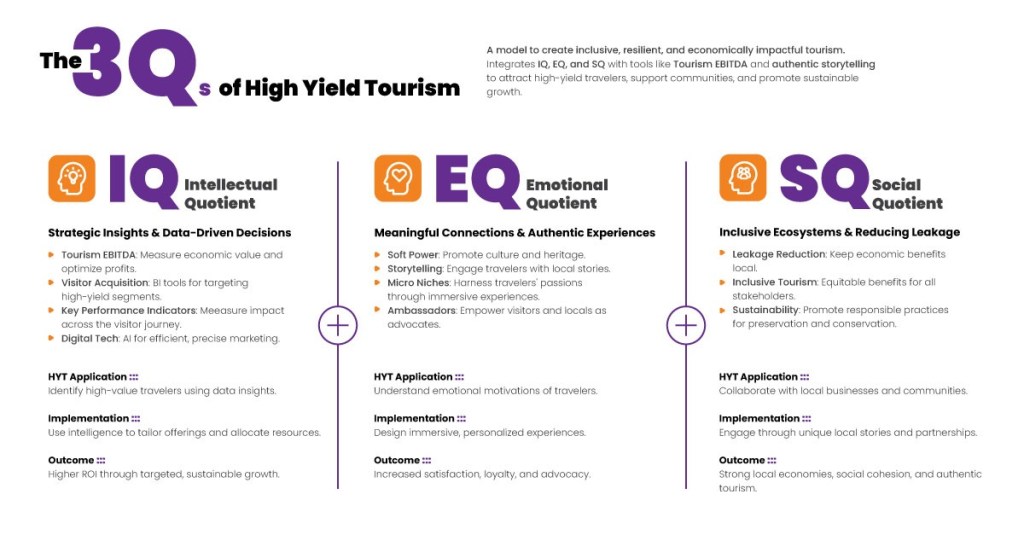
The 3Qs of High-Yield Tourism, developed by Dr. Jens Thraenhart is a model integrating economic (IQ), emotional (EQ), and social (SQ) factors—aims to address these challenges by promoting sustainable growth, community well-being, and environmental resilience.
The integration of IQ, EQ, and SQ establishes a comprehensive model that balances economic growth with social and environmental responsibility. The 3Qs framework is instrumental in:
- Attracting high-yield travelers who contribute significantly to the local economy.
- Empowering communities through inclusive tourism and equitable opportunities.
- Fostering sustainable growth by preserving cultural and natural assets, creating a long-lasting positive impact.
This paper provides a detailed examination of the 3Qs framework, its theoretical foundation, and its application in fostering sustainable destination management.
Methodology
This paper adopts a conceptual framework analysis based on an extensive literature review across tourism management, economics, and sustainability studies. Key elements of the 3Qs framework were derived from synthesizing empirical research and best practices. Case studies of destinations employing high-yield tourism principles provided insights into the operationalization of the framework’s components, offering a foundation for further empirical validation.
Literature Review
High-Yield Tourism
High-yield tourism emphasizes the economic and cultural value of each visitor, focusing on segments that contribute more financially, respect local customs, and engage in responsible travel behaviors (Dwyer & Forsyth, 2008). Studies suggest that high-yield tourism aligns closely with the principles of sustainable tourism by fostering responsible growth and minimizing ecological impact (UNWTO, 2019; Nimanussornkul & Do, 2017).
Destination Management and Sustainability
Effective destination management requires a balanced approach to stakeholder interests, visitor satisfaction, and sustainable development (Ritchie & Crouch, 2003). Existing research highlights the limitations of focusing solely on economic returns, advocating instead for a more holistic model that considers social and environmental impacts (Buhalis & Amaranggana, 2013; Shahzad et al., 2017).
The 3Qs Framework
The 3Qs framework—comprising Intellectual Quotient (IQ), Emotional Quotient (EQ), and Social Quotient (SQ)—represents a holistic approach to sustainable tourism management that emphasizes high-yield, responsible tourism. Each quotient contributes unique but complementary insights, creating a balanced tourism ecosystem that promotes economic, social, and environmental sustainability. The integration of emotional and social factors with traditional economic metrics offers a multi-faceted approach to creating value (Prentice, 2019; Salis, 2021).
A. Intellectual Quotient (IQ): Strategic Insights & Data-Driven Decision-Making

IQ emphasizes the use of data and strategic analysis to maximize economic outcomes, manage resources efficiently, and optimize visitor experiences. This quotient is critical in targeting high-value travelers, reducing operational costs, and ensuring a strong financial foundation for destinations.
Key Components of IQ
- Tourism EBITDA: Tourism EBITDA (Earnings Before Interest, Taxes, Depreciation, and Amortization) provides an in-depth financial assessment that measures a destination’s true economic contribution from tourism. Using EBITDA, destination managers can evaluate profitability by accounting for factors such as infrastructure costs, revenue sources, and economic leakage (Dwyer et al., 2007). This financial metric is essential for distinguishing high-yield segments from less profitable ones, allowing for better resource allocation.
- Practical Example: The Singapore Tourism Board (STB) utilizes financial metrics akin to Tourism EBITDA to measure and enhance the destination’s economic contribution from tourism, assessing not only direct revenue but also costs associated with infrastructure and potential economic leakage. Using Tourism EBITDA as a guiding metric, Singapore achieves high profitability from its tourism sector while maintaining manageable visitor volumes. This focus on economic impact per visitor enables the STB to optimize resource allocation, and prioritize sustainable growth.
- Practical Example: The Singapore Tourism Board (STB) utilizes financial metrics akin to Tourism EBITDA to measure and enhance the destination’s economic contribution from tourism, assessing not only direct revenue but also costs associated with infrastructure and potential economic leakage. Using Tourism EBITDA as a guiding metric, Singapore achieves high profitability from its tourism sector while maintaining manageable visitor volumes. This focus on economic impact per visitor enables the STB to optimize resource allocation, and prioritize sustainable growth.
- True Cost of Visitor Acquisition: The true cost of acquiring a visitor goes beyond marketing expenditure to include operational costs, infrastructure wear, and environmental impact (Buhalis & Amaranggana, 2013). Leveraging BI tools to calculate acquisition costs enables destinations to target travelers whose spending offsets acquisition expenses, thus maximizing ROI.
- Practical Example: New Zealand Tourism employs BI to identify markets that bring high-yield visitors, such as adventure travelers and nature enthusiasts, who tend to spend more and stay longer. By targeting these segments, New Zealand reduces its overall visitor volume while increasing net tourism revenue.
- Practical Example: New Zealand Tourism employs BI to identify markets that bring high-yield visitors, such as adventure travelers and nature enthusiasts, who tend to spend more and stay longer. By targeting these segments, New Zealand reduces its overall visitor volume while increasing net tourism revenue.
- Key Performance Indicators (KPIs): KPIs across the visitor journey—from awareness to loyalty—provide actionable insights into visitor behavior, satisfaction, and economic impact. Tracking these metrics enables destinations to refine offerings and increase traveler retention (Xiang et al., 2021).
- Practical Example: VisitScotland uses KPIs to monitor visitor satisfaction, track the success of marketing campaigns, and measure conversion rates. This feedback loop allows them to continually improve visitor experiences and increase repeat visitation.
- Practical Example: VisitScotland uses KPIs to monitor visitor satisfaction, track the success of marketing campaigns, and measure conversion rates. This feedback loop allows them to continually improve visitor experiences and increase repeat visitation.
- Digital Technologies: Artificial intelligence and predictive analytics are increasingly used in tourism to anticipate traveler behaviors, manage crowds, and optimize marketing efforts. AI-driven insights allow for targeted resource allocation, ensuring that high-value visitors are catered to efficiently while preserving sensitive environments (Salis, 2021).
- Practical Example: The Faroe Islands developed an AI-based platform to manage visitor flow and protect fragile ecosystems. By using data-driven insights, they can adjust visitor patterns in real-time, balancing conservation with tourism revenue.
- Practical Example: The Faroe Islands developed an AI-based platform to manage visitor flow and protect fragile ecosystems. By using data-driven insights, they can adjust visitor patterns in real-time, balancing conservation with tourism revenue.
Apply High-Yield Tourism: Use market intelligence and data-analytics tools to identify high-value traveler segments – and their spending patterns, interests, and cultural preferences.
Implementation: Use tourism intelligence systems to monitor trends, develop customized offerings, and optimize resource allocation.
Outcome: Increased ROI through well-informed investments, tailored product development, and efficient use of resources via a data-driven foundation for sustainable growth.
Importance and Research Implications
The IQ quotient underscores the importance of efficiency and precision in destination management. Future research could further explore how predictive analytics and BI can reduce operational costs and environmental impact, while longitudinal studies could assess the long-term ROI of high-yield segmentation.
B. Emotional Quotient (EQ): Creating Meaningful Connections & Authentic Experiences

EQ focuses on fostering emotional engagement through culturally rich, immersive experiences that deepen visitor connection to the destination. By prioritizing authentic interactions, EQ can increase visitor satisfaction, loyalty, and positive word-of-mouth advocacy.
Key Components of EQ
- Soft Power: Soft power leverages a destination’s cultural assets—its traditions, cuisine, and history—to create meaningful experiences that resonate emotionally with travelers (Prentice, 2019). Destinations that highlight their unique identities often draw visitors seeking transformative, purpose-driven travel experiences.
- Practical Example: Japan promotes its traditional arts, temples, and festivals to appeal to travelers interested in cultural heritage. By focusing on these unique aspects, Japan attracts high-yield visitors who are willing to pay for immersive cultural experiences, thus driving revenue while preserving heritage.
- Practical Example: Japan promotes its traditional arts, temples, and festivals to appeal to travelers interested in cultural heritage. By focusing on these unique aspects, Japan attracts high-yield visitors who are willing to pay for immersive cultural experiences, thus driving revenue while preserving heritage.
- Authentic Storytelling: Authentic storytelling builds a strong narrative around a destination’s heritage, making travelers feel like part of the place rather than mere observers. This technique deepens their connection and encourages repeat visits (Sthapit et al., 2024).
- Practical Example: Bhutan’s “Gross National Happiness” philosophy is central to its tourism narrative. By sharing this unique value system, Bhutan attracts travelers who value mindfulness and well-being, supporting high-yield, low-impact tourism.
- Practical Example: Bhutan’s “Gross National Happiness” philosophy is central to its tourism narrative. By sharing this unique value system, Bhutan attracts travelers who value mindfulness and well-being, supporting high-yield, low-impact tourism.
- Micro Niches: Targeting niche segments, such as eco-tourists or wellness travelers, allows destinations to focus on travelers who seek high-value, immersive experiences. This approach often attracts visitors with strong personal interests in the destination, enhancing spending and stay duration (Vada et al., 2022).
- Practical Example: Costa Rica attracts eco-tourists and wellness travelers with its commitment to conservation and sustainable travel practices. By catering to these micro niches, Costa Rica generates substantial revenue from travelers who are willing to pay more for eco-friendly experiences.
- Practical Example: Costa Rica attracts eco-tourists and wellness travelers with its commitment to conservation and sustainable travel practices. By catering to these micro niches, Costa Rica generates substantial revenue from travelers who are willing to pay more for eco-friendly experiences.
- Ambassador Programs: Encouraging both locals and past visitors to become advocates for the destination creates an organic marketing network. Ambassadors build community pride and strengthen the destination’s reputation through word-of-mouth, making it more appealing to like-minded, high-yield travelers (Zeidan et al., 2023).
- Practical Example: South Africa’s tourism board runs a “Meet Your South Africa” program where locals share stories, inviting visitors to experience the country from a local’s perspective. This authentic endorsement enhances visitor engagement and promotes cultural exchange.
- Practical Example: South Africa’s tourism board runs a “Meet Your South Africa” program where locals share stories, inviting visitors to experience the country from a local’s perspective. This authentic endorsement enhances visitor engagement and promotes cultural exchange.
Apply High-Yield Tourism: Focus on understanding travelers’ emotional drivers for meaningful and memorable experiences.
Implementation: Design immersive cultural experiences and hyper-personalized guest services that stimulate empathy and connection.
Outcome: Enhanced visitor satisfaction, loyalty, and positive word-of-mouth advocacy for attracting repeat and long-stay travelers.
Importance and Research Implications
EQ highlights the growing demand for meaningful travel experiences. Future studies could examine the economic impact of emotional engagement strategies, while field experiments might assess how ambassador programs influence destination image and visitor loyalty over time.
C. Social Quotient (SQ): Building Inclusive Ecosystems & Reducing Leakage

SQ emphasizes inclusivity, local empowerment, and the equitable distribution of tourism benefits. This quotient is crucial for building community support and reducing economic leakage, where tourism revenue exits the local economy.
Key Components of SQ
- Leakage Reduction: Economic leakage occurs when tourism revenue leaves the destination due to reliance on foreign-owned hotels or imported goods. By supporting local businesses and minimizing leakage, destinations can retain more tourism income within the community (Shahzad et al., 2017).
- Practical Example: Kenya’s Mara Naboisho Conservancy model reduces leakage by employing local staff, sourcing supplies locally, and reinvesting revenue into community projects, thus enhancing local economic resilience.
- Practical Example: Kenya’s Mara Naboisho Conservancy model reduces leakage by employing local staff, sourcing supplies locally, and reinvesting revenue into community projects, thus enhancing local economic resilience.
- Inclusive Tourism: Inclusive tourism ensures that marginalized or underserved groups benefit from tourism. This approach promotes social equity and supports broader economic participation, leading to a more balanced tourism ecosystem (Nimanussornkul & Do, 2017).
- Practical Example: Thailand’s “Community-Based Tourism” initiative empowers local communities, including ethnic minority groups, to develop tourism experiences. This model not only generates revenue but also fosters cultural preservation.
- Practical Example: Thailand’s “Community-Based Tourism” initiative empowers local communities, including ethnic minority groups, to develop tourism experiences. This model not only generates revenue but also fosters cultural preservation.
- Long Tail of Travel: Highlighting “hidden gems” encourages tourists to explore lesser-known areas, supporting a wider range of local businesses and reducing pressure on crowded attractions (Pillai et al., 2022).
- Practical Example: In Italy, regional tourism authorities promote small towns as part of the “slow travel” movement. This initiative helps distribute tourism spending to rural areas and sustains small, local businesses.
- Practical Example: In Italy, regional tourism authorities promote small towns as part of the “slow travel” movement. This initiative helps distribute tourism spending to rural areas and sustains small, local businesses.
- Conservation and Preservation: Sustainable and regenerative practices that protect natural and cultural assets are critical for destinations to remain attractive in the long term. Conservation efforts not only protect resources but also create a unique selling point for eco-conscious travelers (Belloumi, 2010).
- Practical Example: The Galápagos Islands strictly control visitor numbers and enforce conservation policies, attracting high-yield travelers who value preservation and are willing to pay premium fees for access.
- Practical Example: The Galápagos Islands strictly control visitor numbers and enforce conservation policies, attracting high-yield travelers who value preservation and are willing to pay premium fees for access.
Apply High-Yield Tourism: Partner with local businesses, community groups, and influencers to create only-in-this-location stories that build emotional engagement.
Implementation: Initiate community interaction programs, social media campaigns, and joint ventures that reflect local values and promote civic pride.
Outcome: Strengthened local economies, enhanced social cohesion, and recognition of the destination for its authenticity, diversity, and commitment to equitable, sustainable tourism.
Importance and Research Implications
SQ addresses the social dimensions of tourism by ensuring that all stakeholders benefit. Future research might explore the relationship between inclusivity initiatives and community resilience, as well as methods to measure the efficacy of conservation policies in attracting high-yield travelers.
Discussion

The integration of IQ, EQ, and SQ within the 3Qs framework enables a comprehensive approach to destination management that balances economic growth with social and environmental responsibility. IQ’s data-driven approach enables efficient targeting of high-value segments, minimizing costs while maximizing returns. EQ fosters a sense of belonging and satisfaction among travelers, building loyalty and advocacy. Meanwhile, SQ ensures that tourism revenue supports local economies and conservation efforts, fostering community resilience and sustainability. This holistic model addresses the limitations of traditional tourism frameworks, which often emphasize short-term economic gains over sustainability. By aligning with the values of responsible travelers, the 3Qs framework not only attracts high-yield visitors but also fosters sustainable growth and community resilience.
Real-world applications of the 3Qs framework illustrate how tourism can balance profitability with cultural, social, and environmental stewardship. By integrating these three quotients, destinations can attract high-yield travelers, reduce negative impacts, and create lasting value for both visitors and communities. This model promotes tourism as a holistic contributor to economic, social, and environmental well-being.
Conclusion
The 3Qs of High-Yield Tourism offers a comprehensive and balanced approach for sustainable destination management. By integrating economic insights (IQ), emotional engagement (EQ), and social inclusivity (SQ, destinations can attract high-value visitors, foster community engagement, and ensure equitable distribution of tourism benefits. This model provides a roadmap for resilient, inclusive, and economically impactful tourism development that is aligned with sustainability principles, and supports destinations in aligning with evolving traveler preferences for responsible and meaningful travel, positioning tourism as a powerful force for positive change.
Implications and Further Research
The 3Qs framework has broad implications for tourism policymakers, destination managers, and community stakeholders. Practical applications may include the development of targeted marketing strategies, enhanced visitor engagement initiatives, and community-driven tourism models.
Further research is needed to test the 3Qs framework across various destination contexts and validate the framework empirically, particularly through longitudinal studies assessing the long-term impacts of high-yield tourism on destinations. Additionally, measurement tools specific to each quotient would be valuable in operationalizing the 3Qs framework, to assess the framework’s long-term effectiveness ensuring that it continues to support sustainable tourism management practices.
References
- Belloumi, M. (2010). The relationship between tourism receipts, real effective exchange rate, and economic growth in Tunisia. International Journal of Tourism Research, 12(5), 550-560.
- Buhalis, D., & Amaranggana, A. (2013). Smart tourism destinations. In Information and communication technologies in tourism 2014 (pp. 553-564). Springer.
- Dwyer, L., Forsyth, P., & Spurr, R. (2007). Contrasting the uses of TSAs and CGE models: Measuring tourism yield and productivity. Tourism Economics, 13(4), 537-551.
- Nimanussornkul, C., & Do, B. (2017). The volatility of international tourism receipts in Thailand. Journal of Tourism Economics, Policy, and Hospitality Management, 5(1), 1-12.
- Pillai, R., Sivathanu, B., & Dwivedi, Y. K. (2022). Tourism information search behavior: A systematic literature review and future research agenda. International Journal of Contemporary Hospitality Management, 34(1), 129-156.
- Prentice, C. (2019). Emotional intelligence and tourist experience: A perspective article. Tourism Review, 75(1), 52-55.
- Salis, S. (2021). The Internet of Behaviors (IoB) in smart tourism: A conceptual framework. Journal of Tourism Futures.
- Shahzad, S. J. H., Shahbaz, M., Ferrer, R., & Kumar, R. R. (2017). Tourism-led growth hypothesis in the top ten tourist destinations: New evidence using the quantile-on-quantile approach. Tourism Management, 60, 223-232.
- Sthapit, E., Prentice, C., Ji, C., Yang, P., Garrod, B., & Björk, P. (2024). Experience-driven well-being and purchase: An alternative model of memorable wine tourism experiences. International Journal of Tourism Research, 26(2).
- Vada, S., Prentice, C., Filep, S., & King, B. (2022). The influence of travel companionships on memorable tourism experiences, well-being, and behavioral intentions. International Journal of Tourism Research, 24(5), 714-724.
- Xiang, Z., Fesenmaier, D. R., & Werthner, H. (2021). Knowledge creation in information technology and tourism: A critical reflection and an outlook for the future. Journal of Travel Research, 60(6), 1371-1388.
- Zeidan, S., Prentice, C., & Nguyen, M. (2023). Securing jobs with individual trait and organizational support? International Journal of Organizational Analysis, 31(6), 2707-2728.

This approach directly linked to our efforts to assist travel and tourism organizations from destinations, DMCs, hotels, attractions, and retail to rethink their tourism growth strategy to focus on high-yield travelers to increase profits and reduce leakages while balancing economic and social impacts for long-term resilience. Please see more information at High-Yield Tourism, and follow our podcast on Spotify and Apple Podcast, and join the conversation on our LinkedIn and Facebook groups.
About the Author
With over 30 years of global travel and tourism expertise, Dr. Jens Thraenhart is the Founding Partner of 25-year-old bespoke strategy consulting firm Chameleon Strategies, co-founder of High-Yield Tourism, the 2nd Vice Chair of the World Tourism Organization’s UN Tourism Affiliate Members, the former Chief Executive Officer of the Barbados Tourism Marketing, Inc. (Visit Barbados), the former Executive Director of the Mekong Tourism Coordinating Office, the founder of private-sector-led tourism marketing organization Destination Mekong, and former Board Member of the Caribbean Tourism Organization (CTO). Recently consulting for the Saudi Tourism Authority, and previously active in China, in 2009, he co-founded acclaimed marketing agency Dragon Trail and published the China Travel Trends books and website. Jens has also held leadership positions with Destination Canada and Fairmont Hotels & Resorts (now Accor). As founder of the Destination Film Forum, he is also a big proponent of the power of storytelling, having been recognized as one of the top 10 Most Influential Leaders in Travel in 2022 by Travel Vertical, ranking first in the category of Creativity and Brand Storytelling, and served on the Jury of the Cannes Lion International Film Awards. Other recognitions for his work include being one of the travel industry’s top 100 rising stars by Travel Agent Magazine in 2003, one of HSMAI’s 25 Most Extraordinary Sales and Marketing Minds in Hospitality and Travel in 2004 and 2005, one of the Top 20 Extraordinary Minds in European Travel and Hospitality in 2014, and honored as one of the Global Travel Heroes in 2021. He completed his Doctor in Tourism Management at The Hong Kong Polytechnic University and graduated from Cornell University with a Masters in Hospitality Management.
 BALANCED TOURISM
Leave a comment