
By Dr. Jens Thraenhart (August 2025)
Chapter Summary
The model consists of five sequential phases: Pinpoint the Passion (identifying passionate communities with unmet needs), Perfect the Product (developing authentic experiences without losing cultural soul), Promote with Precision (targeted marketing within specialized communities), Prompt Advocacy (converting satisfied customers into active promoters), and Performance Measurement (tracking metrics that matter beyond traditional tourism KPIs). The case study demonstrates how Mongolia transformed its tourism industry by focusing on astronomical tourism, achieving 40% higher per-visitor spending, 65% repeat visitation rates, and NPS scores above 80, while preserving cultural authenticity and supporting local communities.
Three months into the COVID-19 pandemic, my phone rang at 7 AM on a Tuesday. The caller ID showed +976—Mongolia.
“Dr. Thraenhart, we need your help,” said the Minister of Environment and Tourism of Mongolia. “Our adventure tourism market vanished overnight. Everyone tells us to pivot to domestic tourism, but frankly, there aren’t enough Mongolians to sustain our industry. We have these incredible night skies, nomadic culture, vast landscapes… but we have no idea how to turn them into something that actually works.”
That conversation launched what became the most rewarding consulting project of my career—and birthed what I now call the 5Ps Model for Passion Tourism. While everyone else was scrambling to restart mass tourism (UNWTO, 2021), Mongolia forced me to think differently: how do you build a tourism strategy from scratch when your only assets are authenticity and your only customers are people who really care?
Eighteen months later, Mongolia’s stargazing tourism was generating 40% higher per-visitor spending than their previous adventure offerings, with 65% repeat visitation rates and Net Promoter Scores above 80. More importantly, fifteen nomadic families had new income streams that actually strengthened their traditional lifestyle rather than threatening it.
The secret wasn’t complicated marketing or expensive infrastructure. It was a systematic approach that I’ve since refined into five sequential phases that any destination can follow—what I call the 5Ps Model.
Why Most Passion Tourism Strategies Fail (And Why the 5Ps Work)
After working with dozens of destinations attempting passion tourism, I’ve noticed the same pattern: enthusiasm, scattered efforts, disappointment. They understand the concept—find passionate communities, create specialized experiences, charge premium prices. But when Monday morning arrives and they’re staring at budgets and timelines, they get lost in the implementation weeds.
The problem isn’t lack of vision. It’s lack of process.
Most destinations approach passion tourism backwards. They start with what they want to sell rather than what passionate communities actually want to buy (Pine & Gilmore, 2019). They build infrastructure before understanding needs. They launch marketing campaigns before developing authentic experiences. They measure success using mass tourism metrics that miss the point entirely (Goodwin, 2017).
The 5Ps Model flips this approach by starting with passionate community discovery and building systematically toward advocacy. Each phase has specific objectives, metrics, and deliverables that create momentum for the next phase.
But here’s what makes it work: patience. Every destination wants immediate results. The 5Ps requires accepting that sustainable passion tourism development takes three years minimum. Mongolia’s success didn’t happen overnight—it emerged through careful community building, relationship development, and iterative improvement based on feedback from actual passionate travelers.

P1: Pinpoint the Passion (But Not the Way You Think)
“What makes your destination special?” That’s the question every tourism consultant asks, and it’s the wrong starting point.
The right question is: “What passionate communities already exist that could connect with your authentic assets?”
Notice the difference. Instead of creating artificial attractions to serve imaginary markets, you’re identifying real communities with demonstrated passion, then discovering authentic connections to your destination’s irreplaceable characteristics (Richards & Wilson, 2007).
Mongolia’s breakthrough came when we stopped thinking about their assets and started researching passionate communities. Adventure tourism was obvious but oversaturated. Cultural tourism was generic. But buried in specialized forums, we discovered extensive discussions among amateur astronomers frustrated with light pollution and overcrowded “dark sky” destinations in developed countries.
These weren’t casual stargazers. They were people who traveled internationally for solar eclipses, who owned thousands of dollars of equipment, who planned vacations around astronomical events. They had money, passion, and unmet needs.
More importantly, they valued authentic cultural experiences alongside their astronomical interests. Mongolia offered something no competitor could replicate: pristine dark skies combined with genuine nomadic culture that included traditional sky navigation techniques.
This discovery phase requires three types of research that most destinations skip:
Digital Ethnography: Spending weeks in specialized forums, Facebook groups, and niche websites to understand what passionate communities actually discuss, what frustrates them, what they’re willing to pay for. This isn’t keyword research—it’s anthropological investigation of tribal behavior (Kozinets, 2019).
Competitive Gap Analysis: Not just “who else offers stargazing,” but “what do passionate astronomers complain about when discussing existing destinations?” Mongolia discovered that most astronomical tourism felt inauthentic—fancy hotels with mediocre sky conditions, or excellent skies with uncomfortable accommodations and zero cultural connection.
Asset-Passion Intersection Mapping: The hardest part—honestly assessing where your authentic assets create genuine value for passionate communities. Mongolia’s nomadic guides weren’t trained astronomers, but they possessed traditional knowledge about seasonal sky changes and navigation techniques that passionate visitors found fascinating.
The outcome of P1 isn’t a marketing segment. It’s a deep understanding of a passionate community’s unmet needs and clear evidence that your destination can fulfill those needs in ways competitors cannot.
P2: Perfect the Product (Without Losing Your Soul)
Here’s where most destinations make their first major mistake: they assume “building for passionate communities” means “adding complexity and expense.”
Wrong. Passionate travelers don’t want luxury hotels with mediocre experiences. They want authentic experiences with reasonable comfort (Novelli, 2005).
Mongolia’s product development focused entirely on enhancing astronomical viewing while preserving authentic nomadic culture. Instead of building observatories, we modified traditional gers with glass tops. Instead of hiring foreign astronomy guides, we trained local herders in basic astronomical knowledge while encouraging them to share traditional sky lore.
The infrastructure investments were modest: elevated platforms for telescope setup, comfortable seating for extended viewing, and heating systems for cold desert nights. The total investment per site was less than $15,000—tiny compared to typical tourism infrastructure projects.
But the experience design was meticulous. Everything served the astronomical passion while celebrating authentic Mongolian culture:
- Arrival timed to sunset for optimal sky conditions
- Traditional meals that could be eaten without disrupting night vision
- Storytelling that wove astronomical observation with traditional navigation techniques
- Astrophotography workshops led by guides who understood both cameras and local landscape conditions
- Morning discussions about observations while sharing traditional breakfast with nomadic families
The key insight: passionate communities don’t want artificial luxury. They want their passion amplified through authentic cultural connection (MacCannell, 2013).
Product development for passion tourism requires different thinking than mass tourism. Instead of appealing to broad preferences, every element serves specific passionate interests while maintaining cultural authenticity. This specificity actually reduces rather than increases development costs because you’re not trying to please everyone.

P3: Promote with Precision (And Stop Wasting Money)
Mongolia’s tourism budget was $50,000 annually. Most destinations spend that on a single trade show booth.
But passionate communities don’t attend general tourism trade shows. They gather in specialized forums, read niche publications, and follow thought leaders within their specific interests (Gretzel et al., 2006).
Our entire marketing strategy focused on three channels:
Specialized Publications: A single full-page ad in Sky & Telescope magazine reached more qualified prospects than any general travel publication. Cost: $8,000. Response: 340 serious inquiries resulting in 85 bookings over 18 months.
Community Forum Engagement: I personally spent six months participating in astronomical forums, sharing educational content about Mongolia’s sky conditions, posting quality astrophotography from location visits, and building credibility within the community. Cost: my time. Result: Mongolia became recognized as an emerging destination among serious astronomers.
Influencer Partnership: We invited three respected astrophotographers to experience Mongolia in exchange for documentation and honest reviews. Their subsequent blog posts, social media coverage, and word-of-mouth recommendations generated more authentic interest than any advertising campaign. Cost: covering their trip expenses ($12,000 total). Impact: 200+ bookings directly attributable to their coverage.
Total marketing spend year one: $20,000. Revenue generated: $340,000.
The precision promotion principle: go where passionate communities already gather rather than trying to bring them to you. This requires patience, authentic engagement, and genuine value creation within specialized communities (Tribe & Mkono, 2017).
Most destinations fail here because marketing departments want measurable campaigns with immediate results. Passionate community engagement builds slowly through authentic relationship development. You can’t buy trust within specialized communities—you have to earn it.
P4: Prompt Advocacy (The Multiplier Effect Nobody Talks About)
Month six of Mongolia’s stargazing program, something unexpected happened. Visitors started bringing friends.
Not just any friends—other passionate astronomers who came specifically because someone they trusted recommended the experience. These referrals spent more money, stayed longer, and brought even more friends.
By month twelve, 40% of bookings came through direct referrals from previous visitors. By month eighteen, that figure reached 65%.
This advocacy development didn’t happen accidentally. It was systematically engineered through what I call “advocacy architecture”—deliberate systems that convert satisfied customers into active promoters (Reichheld, 2003).
The Mongolia Stargazing Society: We created an exclusive membership program for everyone who visited. Members receive annual sky condition reports, equipment recommendations specific to Mongolia’s conditions, advance booking opportunities for special astronomical events, and significant discounts for return visits or referrals.
The Equipment Partnership Program: Passionate astronomers invest heavily in equipment. We partnered with specialized astronomy retailers to offer members exclusive discounts, created equipment rental programs for international travelers, and developed “Mongolia-specific” equipment recommendations that became valuable resources within the astronomical community.
The Annual Gathering: Every August, during optimal viewing conditions, we host “Stars Over the Steppe”—a five-day event combining astronomical observation with cultural immersion. This annual gathering creates anticipation, builds community, and generates extensive social media coverage within astronomical networks.
Local Guide Advocacy: Our trained nomadic guides became active on social media, sharing stunning astrophotography and behind-the-scenes cultural insights. Their authentic voices proved more persuasive than any professional marketing content.
The advocacy multiplier effect is real: satisfied passionate travelers generate three times more referrals than general tourists because they operate within specialized networks of like-minded individuals who trust their recommendations (Kumar et al., 2010).
Building advocacy requires thinking beyond customer satisfaction toward community membership. Passionate travelers want to belong to something special, not just consume experiences.
P5: Performance Measurement (Beyond Vanity Metrics)
Traditional tourism metrics miss the point of passion tourism entirely.
Visitor arrivals? Irrelevant if you’re focused on quality over quantity. Average spend? Misleading if you’re not tracking economic leakage. Hotel occupancy rates? Useless if passionate travelers prefer authentic accommodations.
Mongolia’s success required developing new metrics that actually matter for passion tourism (Dwyer et al., 2016):
Economic Benefit Metrics:
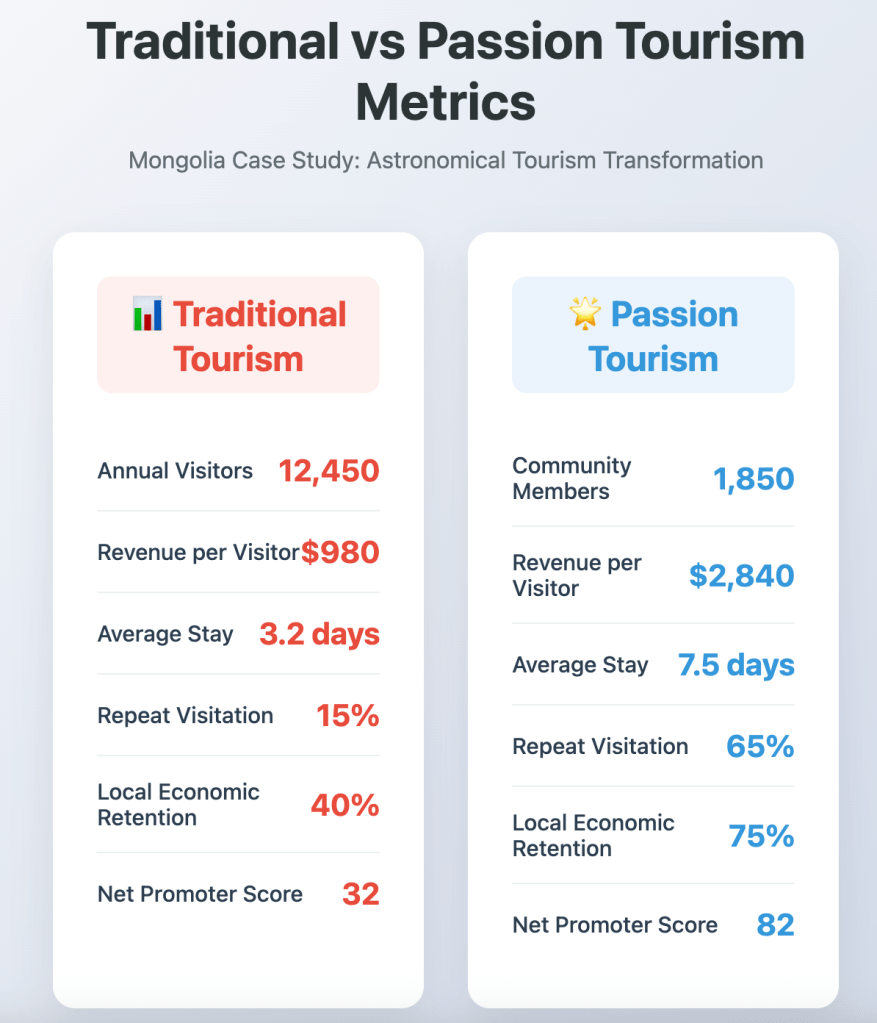
- Revenue per passionate visitor: $2,840 (compared to $980 for previous adventure tourists)
- Local economic retention: 75% (compared to 40% for mass tourism)
- Community income distribution: 15 families directly employed, 45 families in supply chain
Engagement Quality Metrics:
- Net Promoter Score: 82 (anything above 70 indicates exceptional passionate community engagement)
- Repeat visitation rate: 65% within three years
- Referral conversion rate: 73% of referrals result in bookings
Community Impact Metrics:
- Local resident satisfaction: 95% approval rating for astronomical tourism development
- Cultural preservation indicators: Traditional sky navigation techniques now formally documented and actively taught
- Environmental protection outcomes: Dark sky preservation zones established with community support
Passion Community Health Metrics:
- Community growth rate: Mongolia Stargazing Society membership increases 40% annually
- Engagement depth: Average member generates 2.3 referrals within 18 months
- Content creation: Visitors generate 340% more social media content than general tourists
These metrics tell a completely different story than traditional tourism measurement. Instead of counting heads, you’re measuring hearts. Instead of tracking consumption, you’re evaluating contribution (Higgins-Desbiolles, 2018).
Performance measurement for passion tourism requires patience and sophistication. The most important outcomes—community building, cultural preservation, passionate advocacy—develop slowly and resist simple quantification.
Why This Matters Beyond Mongolia
The 5Ps Model works because it addresses the fundamental challenges facing tourism everywhere: oversupply of generic experiences, undersupply of authentic differentiation, and growing traveler sophistication (OECD, 2020).
Passionate communities represent the future of tourism economics. These travelers:
- Spend more money per visit
- Stay longer and visit repeatedly
- Generate authentic advocacy within specialized networks
- Value cultural preservation and environmental protection
- Create economic opportunities for local communities
- Build sustainable competitive advantages that resist commoditization
But serving passionate communities requires different thinking than mass tourism. You can’t fake authenticity, rush community development, or buy credibility within specialized networks (Cohen & Cohen, 2012).
The destinations that thrive in the next decade will be those that master passion tourism development through systematic approaches like the 5Ps Model. Those that continue chasing arrival numbers while communities suffer will discover that passionate travelers—and increasingly, all travelers—are looking elsewhere.
Mongolia proved that small destinations with authentic assets can compete successfully against tourism giants by serving passionate communities exceptionally well. Their success required patience, community partnership, and metrics that measure what actually matters.
The passionate communities are waiting. Your authentic assets are ready. The question isn’t whether the 5Ps Model works—it’s whether you’re ready to begin the journey from mass tourism to passionate community building.
Because in a world drowning in generic experiences, authenticity isn’t just competitive advantage. It’s survival.
Key Insights
- Start with Communities, Not Assets: Traditional tourism development begins with destination assets and seeks markets. The 5Ps Model reverses this by identifying passionate communities first, then matching authentic assets to their specific needs.
- Patience Pays Premium Prices: Passionate travelers pay 290% more per visit than general tourists, but building trust within specialized communities takes time. The three-year development timeline is an investment, not a delay.
- Authenticity Reduces Development Costs: Counter-intuitively, serving passionate communities requires less infrastructure investment than mass tourism. Passionate travelers value authentic experiences over artificial luxury.
- Advocacy Architecture Drives Growth: Systematic advocacy development generates 65% repeat visitation and 73% referral conversion rates. Creating community belonging matters more than customer satisfaction.
- New Metrics for New Tourism: Traditional metrics (arrivals, occupancy, average spend) miss the value of passion tourism. Success requires measuring community health, cultural preservation, and local economic retention.
- Small Destinations Can Compete: Mongolia’s $50,000 annual budget generated $340,000 in revenue through precision targeting. Passionate communities create sustainable competitive advantages that resist commoditization.
- The Future is Already Here: Post-pandemic travelers increasingly seek meaningful experiences over generic consumption. Destinations mastering passion tourism today will lead tomorrow’s industry.
References
Cohen, E., & Cohen, S. A. (2012). Authentication: Hot and cool. Annals of Tourism Research, 39(3), 1295-1314.
Dwyer, L., Forsyth, P., & Dwyer, W. (2016). Tourism economics and policy (2nd ed.). Channel View Publications.
Goodwin, H. (2017). The challenge of overtourism. Responsible Tourism Partnership, 4, 1-19.
Gretzel, U., Fesenmaier, D. R., & O’Leary, J. T. (2006). The transformation of consumer behaviour. In D. Buhalis & C. Costa (Eds.), Tourism business frontiers (pp. 9-18). Butterworth-Heinemann.
Higgins-Desbiolles, F. (2018). Sustainable tourism: Sustaining tourism or something more? Tourism Management Perspectives, 25, 157-160.
Kozinets, R. V. (2019). Netnography: The essential guide to qualitative social media research (3rd ed.). SAGE Publications.
Kumar, V., Petersen, J. A., & Leone, R. P. (2010). Driving profitability by encouraging customer referrals: Who, when, and how. Journal of Marketing, 74(5), 1-17.
MacCannell, D. (2013). The tourist: A new theory of the leisure class. University of California Press.
Novelli, M. (Ed.). (2005). Niche tourism: Contemporary issues, trends and cases. Elsevier Butterworth-Heinemann.
OECD. (2020). OECD Tourism Trends and Policies 2020. OECD Publishing. https://doi.org/10.1787/6b47b985-en
Pine, B. J., & Gilmore, J. H. (2019). The experience economy: Competing for customer time, attention, and money. Harvard Business Review Press.
Reichheld, F. F. (2003). The one number you need to grow. Harvard Business Review, 81(12), 46-54.
Richards, G., & Wilson, J. (2007). Tourism, creativity and development. Routledge.
Tribe, J., & Mkono, M. (2017). Not such smart tourism? The concept of e-lienation. Annals of Tourism Research, 66, 105-115.
UNWTO. (2021). International Tourism Highlights, 2020 Edition. World Tourism Organization. https://doi.org/10.18111/9789284422456

This approach directly linked to our efforts to assist travel and tourism organizations from destinations, DMCs, hotels, attractions, and retail to rethink their tourism growth strategy to focus on high-yield travelers to increase profits and reduce leakages while balancing economic and social impacts for long-term resilience. Please see more information at High-Yield Tourism, and follow our podcast on Spotify and Apple Podcast, and join the conversation on our LinkedIn and Facebook groups.
About the Author
With over 30 years of global travel and tourism expertise, Dr. Jens Thraenhart is the Founding Partner of 25-year-old bespoke strategy consulting firm Chameleon Strategies, co-founder of High-Yield Tourism, the 2nd Vice Chair of the World Tourism Organization’s UN Tourism Affiliate Members, the former Chief Executive Officer of the Barbados Tourism Marketing, Inc. (Visit Barbados), the former Executive Director of the Mekong Tourism Coordinating Office, the founder of private-sector-led tourism marketing organization Destination Mekong, and former Board Member of the Caribbean Tourism Organization (CTO). Recently consulting for the Saudi Tourism Authority, and previously active in China, in 2009, he co-founded acclaimed marketing agency Dragon Trail and published the China Travel Trends books and website. Jens has also held leadership positions with Destination Canada and Fairmont Hotels & Resorts (now Accor). As founder of the Destination Film Forum, he is also a big proponent of the power of storytelling, having been recognized as one of the top 10 Most Influential Leaders in Travel in 2022 by Travel Vertical, ranking first in the category of Creativity and Brand Storytelling, and served on the Jury of the Cannes Lion International Film Awards. Other recognitions for his work include being one of the travel industry’s top 100 rising stars by Travel Agent Magazine in 2003, one of HSMAI’s 25 Most Extraordinary Sales and Marketing Minds in Hospitality and Travel in 2004 and 2005, one of the Top 20 Extraordinary Minds in European Travel and Hospitality in 2014, and honored as one of the Global Travel Heroes in 2021. He completed his Doctor in Tourism Management at The Hong Kong Polytechnic University and graduated from Cornell University with a Masters in Hospitality Management.
 BALANCED TOURISM
Leave a comment