
By Dr. Jens Thraenhart (October 2025)
How an Adapted Business Model Is Revolutionizing Destination Planning: From Volume to Value
soar
/sɔː/
verb: achieving new heights; to rise very quickly to a high level
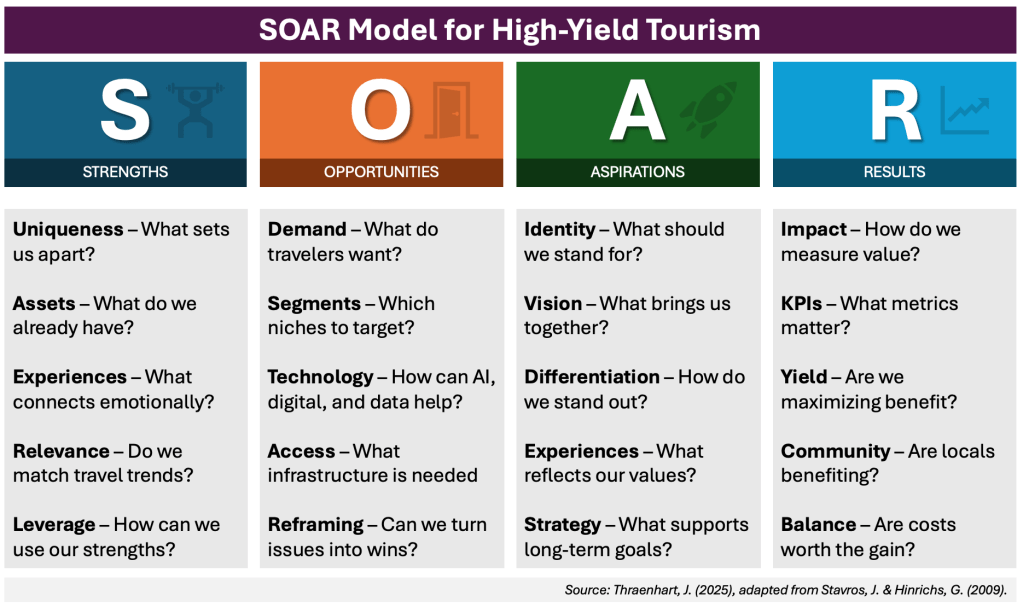
A New Lens for Tourism Planning: The SOAR Approach
When Jacqueline Stavros and Gina Hinrichs introduced the SOAR model in 2009, their goal was to move strategy conversations from problem-finding to possibility-seeking to address a fundamental challenge in organizational development: how do you create strategies that build on strengths rather than simply fixing weaknesses? Fast-forward to 2025, and destinations worldwide are grappling with remarkably similar questions. How do we move beyond chasing visitor numbers toward creating meaningful value? How do we turn tourism into a genuine force for good?
After two decades working with destinations worldwide, I’ve observed how traditional planning frameworks, while valuable, often focus significant energy on problems rather than possibilities. SWOT analysis has served the tourism industry well, providing systematic assessment of strengths, weaknesses, opportunities, and threats. Yet in practice, I’ve noticed how sessions examining weaknesses and threats can inadvertently shift focus toward defensive strategies rather than inspiring growth.
Based on these observations, I have adapted and refined the classic 15-year-old SOAR business model into a revolutionary framework specifically designed for travel and tourism organizations ready to transcend volume-based strategies. The SOAR Model for High-Yield Tourism represents my proprietary methodology that can help destinations attract passionate, high-value travelers while creating sustainable community prosperity.
This parallels insights from organizational psychology, particularly the StrengthsFinder approach popularized by Gallup research showing that individuals and organizations achieve greater success by building on natural strengths rather than solely fixing weaknesses. This doesn’t mean ignoring challenges, but it means choosing where to direct primary energy and attention.
While the original SOAR model transformed businesses, my tourism-specific adaptation addresses the unique challenges destinations face: overtourism, community resistance, authentic differentiation, and the urgent need to attract travelers who give more than they take. This isn’t just another planning tool. It’s a proven system that fundamentally shifts how destinations think about growth, value, and impact. This isn’t about chasing more tourists. It’s about attracting the right ones, those who stay longer, spend more, connect deeper, and leave a positive footprint, to build a tourism strategy that’s both profitable and purposeful.
This approach reframes how destinations think about value. Instead of chasing raw visitor numbers or chasing spend at any cost, SOAR guides travel and tourism leaders to focus on their unique essence, to attract aligned, passionate enthusiasts of micro-niche tribes, and to multiply impact far beyond vanity metrics.
Strengths: What makes you irreplaceable? What are our greatest strengths? (Culture, leadership, natural assets, unique stories)
Opportunities: Which passionate tribes align with your purpose? Where are the most promising opportunities? (Emerging markets, authentic experiences, purpose-driven travel)
Aspirations: What do you stand for beyond profit? What are our boldest aspirations? (Destination stewardship, community prosperity, transformative visitor journeys)
Results: How do you measure meaning, not just money? Which results will we celebrate? (Community support, advocacy, sustainable growth, repeat visitation)
This adapted SOAR model emerged from my own experiences of real destination transformations:
- Saudi Arabia: Leveraging Hafawa (authentic hospitality) as a Soft Power asset
- Cambodia: Elevating beyond temples to cultural pilgrimage experiences
- Vietnam: Turning cycling enthusiasts into economic multipliers for rural communities
- Thailand: Beyond Beaches to Cultural Mastery, leveraging Thainess (and the 5Fs)
- Mongolia: Nomadic Wisdom as Living Heritage to be positioned as Digital Detox Transformation
- Barbados: Showcasing Caribbean excellence in education, culture, sports, and culinary
- Canada: Indigenous Knowledge Meets Natural Majesty where First Nations communities are primary beneficiaries and storytellers
Each destination discovered that when you start with strengths, identify purpose-aligned opportunities, articulate authentic aspirations, and measure meaningful results, everything changes.
High-Yield Tourism applies this strength-based thinking to destination strategy. Rather than targeting “everyone” or competing on features destinations lack, it focuses on optimizing what makes each place genuinely distinctive. High-yield travelers stay longer, spend more, engage meaningfully with local culture, and become passionate ambassadors. The goal is creating resilient, sustainable visitor economies benefiting all stakeholders – residents, businesses, governments, and travelers.
Purpose: The Missing Piece in Destination Strategy
For too long, destinations have chased volume, and have focused on the “what” and “how” of tourism, often at the expense of local communities, infrastructure, and authentic experiences, while ignoring the most crucial question: “Why do we exist as a destination?” This isn’t about why tourists should visit. It’s about understanding your destination’s purpose, its soul, its DNA, the reason it matters in the world.
Purpose is everything. It defines not just what experiences you offer, but why your destination deserves to exist in travelers’ minds and hearts. It answers why your community should embrace tourism, why partners should invest, why travelers should care. Without purpose, you’re just another place with beaches, mountains, or museums. With purpose, you become irreplaceable.
I’ve watched destinations transform when they discover their true purpose. It’s not manufactured in marketing campaigns. It exists already, waiting to be articulated. And when you find it, everything changes. Purpose acts like a magnetic force, attracting travelers who share your values, partners who amplify your mission, and residents who become proud ambassadors.
Here’s what most destinations miss: people don’t travel for perfect weather or flawless infrastructure. They travel for how a place makes them feel. The most successful destinations I’ve observed understand this emotional truth. They don’t apologize for their imperfections; they weave them into their story.
When Purpose Meets Passion: The Ultimate Connection
Here’s what I’ve discovered: passionate travelers aren’t just looking for experiences. They’re seeking purpose alignment. They want their travel choices to reflect their values, support causes they believe in, and connect them with places that stand for something meaningful.
Today’s high-yield travelers, especially millennials and Gen Z, choose destinations like they choose brands: based on shared purpose. A recent study found that 83% of millennials consider value alignment essential in their purchasing decisions (Source: 5WPR, 2020 – https://www.prdaily.com/report-83-of-millennials-want-brands-to-align-with-them-on-values/). In tourism, this translates to choosing destinations that don’t just offer experiences but embody purposes they can support.
When travelers discover a destination whose purpose resonates with their own values, price becomes secondary. They’re not buying a vacation; they’re investing in a purpose they believe in.
The most successful destinations I’ve observed share one trait: they know why they exist beyond generating tourism revenue. When Rwanda committed to conservation as their purpose, they didn’t just attract tourists, they magnetized passionate conservationists who plan trips years in advance, donate beyond their permits, and become lifelong advocates.
One passionate dark sky enthusiast in Mongolia’s Gobi Desert can potentially generate more local income than an entire busload of conventional tourists. They can hire nomadic families, purchase traditional crafts, fund dark sky preservation. This isn’t trickle-down economics, it’s direct value transfer to communities.
In successful SOAR-driven initiatives, purchasing decisions are often guided by local community leaders, those who understand the pulse of their niche, whether it’s ecotourism, cultural heritage, or wellness retreats. These communities define purpose, attract like-minded guests, and transform passion into patronage from key markets.
The Air Connectivity Paradox: Why Less Can Be More
Here’s something that might shock traditional tourism planners: limited air connectivity isn’t always a weakness. It can be a great strategic filter.
I learned this firsthand in Bhutan. While neighboring destinations scrambled to secure every possible airline route, Bhutan’s selective air access became their strength. The photographers, Buddhist scholars, and wellness seekers who navigate multiple connections to reach Paro aren’t casual tourists. They’re passionate pilgrims who’ve invested time, money, and effort before they even arrive. That investment translates into deeper engagement, longer stays, and profound advocacy.
But this is not about celebrating isolation. It’s about understanding how air connectivity shapes your visitor ecosystem.
When I analyzed successful high-yield destinations, a pattern emerged. The Faroe Islands don’t need daily flights from every major city. They need strategic connections to markets where their passionate tribes, from landscape photographers, Nordic culture enthusiasts, to sustainable tourism advocates are concentrated. One weekly flight from Copenhagen filled with devoted visitors creates more value than daily charters of deal-seekers.
I’ve watched destinations transform their air strategy by applying SOAR principles:
Slovenia stopped chasing mass-market carriers and focused on connections to cities with high concentrations of outdoor enthusiasts. Result? Higher spending per visitor, longer stays, and visitors who return for different seasons.
Tasmania resisted pressure to court budget airlines from everywhere. Instead, they strengthened links to Melbourne and Sydney, where their target tribes of food pilgrims and wilderness seekers were already concentrated. These visitors arrive pre-qualified, ready to invest in experiences.
Your passionate micro-niches will move mountains to reach you. I’ve seen:
- Whisky connoisseurs take three flights to reach Islay’s distilleries
- Aurora photographers endure 24-hour journeys to reach optimal viewing locations
- Textile artists navigate complex routes to study with master weavers
These travelers don’t see connectivity challenges as barriers. They see them as part of the pilgrimage. The journey becomes part of the story they’ll tell for years.
But here’s where it gets strategic. When you understand your passionate tribes, you can develop surgical air connectivity that serves them brilliantly:
- Seasonal specialist routes: Winter-only connections for ski mountaineers, summer routes for migratory bird watchers
- Event-triggered capacity: Additional flights aligned with festivals that matter to your tribes
- Partnership approaches: Working with airlines that understand high-yield travel, not just high-volume
One partnership connected a remote Indonesian island with Singapore just twice weekly. Traditional analysis would call this insufficient. Yet those flights are consistently full of diving enthusiasts who book entire weeks, hire local guides, and return annually. Two flights generating more local value than twenty might.
The SOAR framework reveals what traditional planning misses: your air connectivity strategy should filter as much as it facilitates. Every route should align with your strengths, serve your opportunities, advance your aspirations, and deliver your desired results.
Ask yourself:
- Are we chasing connectivity for volume or for value?
- Do our air routes bring visitors who align with our purpose?
- Are we measuring success in passenger numbers or in passion generated?
Traditional thinking says more routes equal more success. SOAR thinking asks: which routes bring the right travelers?
The secret lies in what I call “purposeful connectivity.” It’s not about being connected to everywhere. It’s about being purposefully connected to somewhere.
Real Influence vs. Vanity Metrics
Resilient tourism is about more than just arrivals. It is advocacy, turning visitors into passionate advocates who continue to tell your story long after they’ve returned home. When we lead strategically using SOAR, destinations have shown that showcasing their authentic excellence attracts high-value visitors and builds community pride, rather than merely competing on generic attractions.
Your Destination Already Has Passionate Advocates
Somewhere in the world, there’s a tribe of travelers who would overcome any obstacle to experience what makes your destination unique. They don’t care that you don’t have the best beaches or the biggest mountains. They care that you have something they can’t find anywhere else.
The question is: Do you know who they are? Do you know how to find them? Do you have the courage to say no to everyone else?
The 500,000-Follower Illusion
Here’s what might surprise you: That travel influencer with half a million followers? They might not be your answer. The real power may lie with the bird-watching guide who has 5,000 devoted followers who hang on every recommendation. When she says a destination is worth visiting, her tribe doesn’t just listen, they follow, book flights, hire local guides, and return year after year.
This is the difference between awareness and action. Between likes and loyalty. Between visitors and advocates.
The Evolution of Strategic Planning
When Jacqueline Stavros and Gina Hinrichs introduced SOAR in 2009, they addressed a fundamental question: how do we create strategies that build on strengths while still acknowledging realities? SOAR – Strengths, Opportunities, Aspirations, and Results – offers a complementary approach to traditional planning.
This isn’t about pretending challenges don’t exist. Destinations must absolutely understand their constraints, competitive pressures, and potential risks. The difference lies in emphasis and energy allocation. Where traditional planning might spend equal time on all four SWOT quadrants, SOAR consciously chooses to invest primary focus on strengths and opportunities while maintaining awareness of limiting factors.
Consider Slovenia’s strategic evolution. Rather than dwelling on having smaller ski areas than Austria or Switzerland, they recognized their unique position as Europe’s green heart where visitors could ski mornings and swim the Adriatic by afternoon. They built on this distinctive strength rather than trying to compete where they were disadvantaged.
Or consider the Faroe Islands. Too remote. Too rainy. Too small. Every traditional consultant would list these as weaknesses to overcome. Yet today, they attract premium-paying photographers and cultural enthusiasts who see that remoteness as luxury, that weather as drama, that size as authenticity. They stopped apologizing for what they weren’t and started amplifying what they were.
Tourism’s Unique Planning Context
Tourism differs fundamentally from other sectors. Destinations are living ecosystems shaped by culture, heritage, nature, and community aspirations—not products to engineer or manufacture. This complexity requires planning approaches that respect these dynamics.
Traditional business frameworks remain valuable diagnostic tools. Understanding weaknesses helps identify necessary improvements. Recognizing threats enables prudent risk management. However, I’ve observed that destinations achieving transformational success share a common pattern: they direct primary energy toward amplifying strengths and pursuing aligned opportunities.
Why Tourism Needs Its Own Strategic Framework
Traditional business frameworks fail tourism because they weren’t designed for destinations. When I adapted the 15-yeard-old SOAR framework specifically for high-yield tourism, I addressed the unique challenges we face:
- Multiple Stakeholders: From taxi drivers to ministers, everyone must share the vision.
- Living Heritage: You can’t manufacture authenticity or control culture.
- Passionate Micro-Niches: The future isn’t mass markets, it’s devoted micro-niche enthusiats.
- Purpose-Driven Travelers: 83% of millennials choose brands based on values alignment (Source: 5WPR, Consumer Culture Report, 2020)
The SOAR Model for High-Yield Tourism isn’t just another planning tool. It’s a proven system that transforms how destinations attract visitors who matter.
What if you could:
- Stop competing on price and start winning on purpose?
- Transform your perceived weaknesses into powerful filters for the right travelers?
- Measure success in shared stories, not just statistics gathered?
- Unite your entire destination – from taxi drivers to ministers – around a shared vision?
At its core, SOAR for High-Yield Tourism answers three critical questions:
- WHO are we attracting? (Not how many – focusing on quality over quantity)
- WHAT experiences are we creating? (Not what amenities we’re building – emphasizing authenticity and value)
- WHY does it matter? (Not just to us, but to everyone involved – ensuring positive impact for all stakeholders)
These questions form the foundation of my 3Qs framework I developed, combining Intellectual Quotient (data and strategy), Emotional Quotient (authentic connections), and Social Quotient (community benefit).
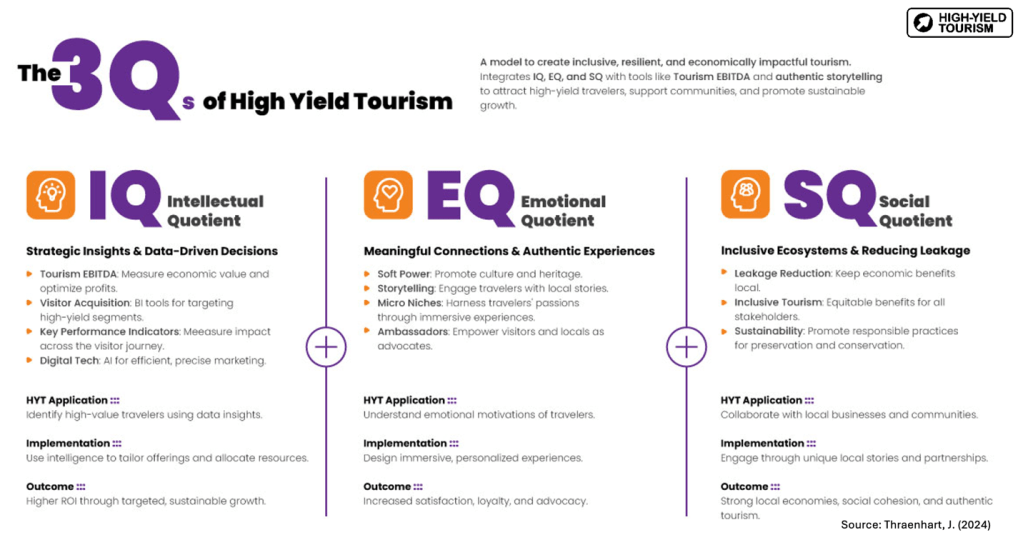
- Intellectual Quotient (IQ): Leveraging data and strategic insights to target high-value markets, track tourism EBITDA, and enable data-driven decision-making.
- Emotional Quotient (EQ): Fostering meaningful connections via authentic storytelling, micro-niche experiences, and local ambassadors who embody the spirit and values of the destination.
- Social Quotient (SQ): Ensuring inclusivity, reducing economic leakage, and empowering local communities so the benefits of tourism are distributed equitably—a non-negotiable for sustainable growth
The Adapted SOAR Framework for Tourism
My adaptation of SOAR for High-Yield Tourism maintains the model’s appreciative foundation while incorporating tourism-specific considerations:
Strengths: What authentic, irreplaceable assets does your destination possess? These include not just attractions but knowledge, traditions, natural features, and community capabilities that passionate travelers value.
Opportunities: Which global passionate communities align with your strengths? Rather than targeting broad demographics, this identifies specific tribes whose interests match your authentic offerings.
Aspirations: What does your community want tourism to achieve beyond economic returns? This encompasses cultural preservation, environmental regeneration, and social wellbeing.
Results: How do we measure success beyond arrival numbers? This includes visitor transformation, community benefit, cultural vitality, and regenerative impact.
Important clarification: This approach doesn’t ignore challenges. Infrastructure limitations, seasonality, accessibility issues, and competitive pressures remain real considerations. The distinction is treating these as context to navigate rather than focal points dominating strategy sessions. When weaknesses require attention, address them—but don’t let fixing problems overshadow building on possibilities.
SOAR: A Purpose-Driven Framework for Destination Transformation
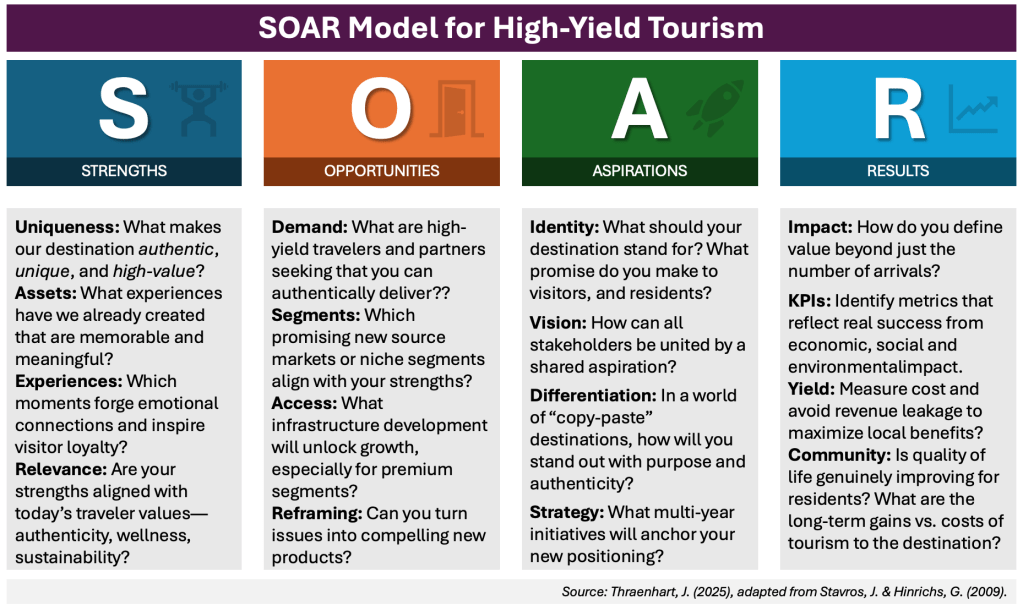
The SOAR Model for High-Yield Tourism places purpose at its core. While traditional planning starts with assets and markets, we start with a fundamental question: What is your destination’s purpose for existing?
This purpose then guides:
- Which Strengths to amplify (those that serve your purpose)
- Which Opportunities to pursue (those that align with your purpose)
- Which Aspirations to articulate (those that express your purpose)
- Which Results to measure (those that prove your purpose creates value)
Strengths: Start from Your Core
Understanding a destination’s inherent strengths is the bedrock of the Passion-Tourism Economy to drive High-Yield Tourism. It’s about looking beyond the obvious and identifying what truly sets a place apart. The first pillar asks destinations to identify what makes them genuinely unique and valuable.
- Uniqueness – What sets us apart?
- Assets – What do we already have?
- Experiences – What connects emotionally?
- Relevance – Do we match travel trends?
During my nearly eight years leading the regional tourism collaboration of the six member countries of the Greater Mekong Subregion in Southeast Asia, I witnessed how Thailand could leverage its authentic strengths. Rather than competing with Singapore on modernity or Japan on efficiency, the Kingdon embraced its unique blend of spiritual heritage, culinary passion, and genuine hospitality. The “Amazing Thailand” campaign worked because it reflected real strengths that visitors could feel in every interaction.
The key strength questions I ask every destination:
- What would disappear from the world if your destination didn’t exist?
- Which experiences make visitors call friends immediately after?
- What do your residents miss most when they travel elsewhere?
- What passionate tribes already love you for who you are?
Working currently at the Saudi Tourism Authority as an Advisor, I learned that it is important for Saudi Arabia not to try to compete with Dubai’s glitz. Instead, the opportunity lies in focusing on their unmatched assets: being the birthplace of civilizations, having the world’s largest continuous sand desert, and offering access to previously closed archaeological wonders. Targeting passionate cultural explorers and adventure seekers who valued exclusive access over easy comfort.
Opportunities: Finding Your Passionate Tribes
The tourism landscape is shifting fast. AI, digital platforms, and changing traveler values are opening doors to new segments and markets. But opportunity without readiness is a missed chance. Traditional opportunity analysis often focuses on untapped markets or underutilized assets. The high-yield tourism adaptation goes deeper, asking how we can attract visitors who align with our values and contribute meaningfully to our communities.
- Demand – What do travelers want?
- Segments – Which niches to target?
- Access – What infrastructure is needed?
- Reframing – Can we turn issues into wins?
Here’s what excites me about tourism’s future: the real opportunities aren’t in attracting more tour groups or building bigger resorts. They’re in connecting with passionate micro-niches who will become your fiercest ambassadors.
Rwanda understood this brilliantly. After unimaginable tragedy, they could have pursued mass tourism. Instead, they focused on high-yield conservation tourism. Today, travelers pay $1,500 to spend an hour with mountain gorillas. But here’s the key: these aren’t just wealthy tourists. They’re passionate conservationists who plan their entire year around this experience, who donate beyond their permits, who share their stories for decades.
From my work in Cambodia, I learned how Siem Reap transformed from merely “the place with Angkor Wat” to a destination for passionate cultural explorers. They developed experiences around traditional crafts, village life, and Khmer culture that attracted travelers who stayed longer and ventured beyond the temples (GIZ https://giz-cambodia.com/siem-reap-beyond-the-temples-promoting-community-based-tourism-in-siem-reap-province-and-beyond/). These passionate culture seekers spent more time and money with local communities than ten tour buses combined.
I urge destinations to explore:
- Which passionate communities already advocate for you without being asked?
- What would people miss if it disappeared from your destination?
- How can you turn your constraints into filters for the right travelers?
- Which global tribes align with your authentic identity?
Bhutan turned visa fees and limited capacity into a self-selecting mechanism for conscious travelers. Finland turned cold winter darkness into a pilgrimage site for Northern Lights chasers. Your perceived weaknesses might be your strongest filters for finding your tribe.
Aspirations: Purpose as Your North Star
In a sea of look-alike destinations, standing out means standing for something. Your aspiration should be more than a slogan. It should be a shared vision that resonates with locals and visitors alike.
- Identity – What should we stand for?
- Vision – What brings us together?
- Differentiation – How do we stand out?
- Strategy – What supports long-term goals?
This is where most destinations fail. They want to be liked by everyone, so they stand for nothing, and turn into what I call the “beigification trap”. The “Destination Beige” is pleasant, forgettable, interchangeable. But this is where purpose transforms from concept to strategy. Most destinations confuse aspiration with ambition. They aspire to “be the leading destination” or “attract more high-yield visitors.” That’s not aspiration; that’s arithmetic.
True aspiration stems from purpose. It’s the conscious expression of why your destination exists and how that purpose guides every decision: which travelers to attract, which experiences to develop, which partnerships to pursue, which impacts to measure.
When I led tourism marketing in Barbados, I felt that the focus should not be on soley focusing on beautiful beaches and attracting more wealthy visitors. The purpose should be deeper: to showcase how the Caribbean nation’s excellence in education, culture, surfing, horticulture, and culinary arts could inspire the world. This purpose was to attract travelers who valued intellectual engagement over idle luxury. This guided decisions on how to develop culinary experiences like the Food & Rum Festival over mega-resorts. It inspired residents to share their knowledge, not just their beaches.
Palau’s purpose to protect their pristine environment for future generations led to the revolutionary Palau Pledge. They weren’t trying to attract the most customers. They were filtering for travelers who shared their purpose. The result? Visitors who contribute to conservation, not only the economy.
Your purpose-driven aspiration should answer:
- Why does our destination deserve to exist in a world of infinite choices?
- What would the world lose if we disappeared tomorrow?
- Which travelers share our purpose and will fight to protect it?
- How does our purpose guide every strategic decision?
Purpose isn’t what you do. It’s why you exist. And in high-yield tourism, travelers pay premium prices to support destinations whose purpose aligns with their values.
Results: Measuring Purpose-Driven Impact
Here’s where the SOAR model for high-yield tourism most dramatically differs from traditional approaches. Success isn’t measured just by arrival numbers or direct tourism revenue, but it’s evaluated through net positive impact across economic, social, and environmental dimensions.
- Impact – How do we measure value?
- KPIs – What metrics matter?
- Yield – Are we maximizing benefit?
- Community – Are locals benefiting?
The most sophisticated destinations are developing balanced scorecards that measure whether tourism truly serves as a force for good. Are residents’ quality of life improving? Are cultural traditions being preserved and celebrated rather than commodified? Is the destination becoming more resilient and distinctive rather than more generic?
I’m tired of tourism strategies that celebrate arrival numbers while residents can’t afford housing. Real success in passion tourism requires different metrics.
When your destination operates from clear purpose, success metrics shift dramatically. You stop measuring only economic impact and start tracking purpose alignment:
- Purpose Resonance Score: How deeply do visitors connect with your destination’s purpose?
- Values Alignment Index: Are you attracting travelers who share your core values?
- Purpose Advocacy Rate: Do visitors become activists for your cause?
- Community Purpose Pride: Do residents feel tourism reinforces their identity?
- Partner Purpose Alignment: Are businesses operating in sync with destination purpose?
- Ambassador Index: How many visitors become active advocates?
- Passion Yield: Revenue from micro-niche segments vs. mass market
- Regenerative Impact: Are passionate visitors improving the destination?
During my work in Mongolia, we discovered their purpose wasn’t just preserving nomadic culture, it was proving that ancient wisdom could teach modern society about sustainable living. This purpose attracted not just cultural tourists but sustainability leaders, educators, and change-makers who paid premium prices for transformative experiences.
During my work in Vietnam, we discovered that cycling enthusiasts spending two weeks on the Ho Chi Minh Trail generated more local economic impact than dozens of standard package tours. They ate in local restaurants, stayed in family guesthouses, and returned with friends. That’s the multiplier effect of passion-tourism aligned with purpose.
Putting SOAR into Action
Every destination has a purpose. Most just haven’t articulated it. The SOAR Model for High-Yield Tourism doesn’t create purpose, it reveals what already exists in your destination’s DNA, then builds strategy around it.
The destinations winning today aren’t those with perfect weather or flawless service. They’re those who understand that passionate travelers will overcome any obstacle for experiences that touch their souls. Bad weather becomes atmosphere. Difficult access becomes exclusivity. High prices become investment in values.
Below are a few destinations from my personal professional experience. Each case proves that starting with strengths and authentic aspirations creates more powerful and sustainable results than deficit-based planning or copying competitor strategies:
- Start with authentic cultural strengths (not manufactured attractions)
- Moving beyond the obvious (past oil/temples/beaches/war narratives)
- Empower local communities as primary beneficiaries and storytellers
- Quality over quantity – transformation over transactions
- Measure what matters – cultural preservation + economic impact
- Regional equity – benefits beyond capital cities
- Soft power positioning – culture as competitive advantage
Saudi Arabia: Hafawa as Soft Power
Strengths: Deep-rooted Hafawa (hospitality) tradition as cultural cornerstone, UNESCO World Heritage sites (Al-Ula, Diriyah, Jeddah), dramatic desert and mountain landscapes, authentic Bedouin culture, coffee ceremony traditions, nascent but ambitious Vision 2030 momentum, untapped cultural narratives
Opportunities: Position Hafawa as Saudi’s unique differentiator in global tourism, develop cultural immersion experiences showcasing generosity traditions, create heritage routes connecting ancient trade paths, leverage AlUla as anchor for cultural tourism, develop specialty tourism (astronomy, adventure, wellness in desert settings), attract cultural pilgrims beyond religious pilgrimage
Aspirations: Transform global perceptions by leading with authentic hospitality, becoming the model for how cultural soft power can reshape national narrative, establishing Saudi as a must-experience destination for cultural explorers seeking authenticity over luxury alone
Results: International visitor sentiment shifts, Hafawa experience delivery metrics, local community participation rates in tourism, cultural ambassador training completion, economic impact in heritage regions, Saudi cultural narrative penetration in global media
Cambodia: Beyond Temples to Pilgrimage
Strengths: Angkor Wat as powerful draw but broader Khmer cultural depth, resilient Buddhist spiritual traditions, silk weaving heritage (especially Takeo), apsara dance as living art form, emotional national story of recovery and hope, genuine warmth despite historical trauma, emerging culinary identity
Opportunities: Develop cultural circuits beyond Siem Reap connecting temples to living culture, create artisan village networks (silk, pottery, silverwork), position as spiritual wellness destination integrating Buddhist practices, develop Tonle Sap cultural experiences with floating communities, create “recovery and resilience” narrative tourism, establish culinary trails showcasing Khmer cuisine distinct from Thai/Vietnamese
Aspirations: Evolve from “temple selfie destination” to cultural pilgrimage where visitors engage with living Khmer culture, spiritual practices, and artisan communities, creating meaningful economic impact beyond Angkor gates while honoring Cambodia’s journey
Results: Visitor dispersion beyond Siem Reap, average length of stay increases, artisan direct income, temple town vs. total Cambodia spending ratio, cultural experience participation rates, repeat visitation, visitors reporting “transformative” vs. “transactional” experience
Barbados: Caribbean Excellence Redefined
Strengths: English-speaking with excellent education system, rich literary heritage (birthplace of Caribbean voices), Crop Over festival as authentic celebration, cricket excellence and sports culture, rum heritage and culinary sophistication, stable governance and infrastructure, strong middle class, Bajan pride and cultural confidence
Opportunities: Position as “Caribbean’s cultural capital” showcasing intellectual and creative excellence, develop heritage tourism around UNESCO-listed Bridgetown and Garrison, create culinary tourism leveraging flying fish, cou-cou, and rum culture, develop sports tourism beyond cricket (surfing, sailing), establish as education/cultural exchange hub, leverage Crop Over as signature cultural event attracting global audiences
Aspirations: Transform perception from “beach resort island” to Caribbean’s showcase of excellence, where education, culture, sports, and culinary arts demonstrate island sophistication, becoming the Caribbean destination that challenges stereotypes
Results: Cultural tourism as % of total arrivals, average visitor spend, local artist/chef/athlete income from tourism, Bajan participation rates in tourism economy, education exchange programs established, global media coverage of cultural (not just beach) attributes, year-round (not just winter) tourism growth
Vietnam: Cyclists as Rural Economic Catalysts
Strengths: Spectacular cycling terrain (mountains, coast, rice terraces), cycling enthusiasts as high-value, low-impact visitors, existing cycling tour infrastructure, rural communities eager for sustainable income, Vietnamese warmth and curiosity, diverse landscapes within manageable distances, excellent cuisine for fuel/experience, safety for foreign cyclists
Opportunities: Develop community-based homestay networks along cycling routes, create “pedal and plate” culinary cycling experiences, establish repair/guide cooperatives in rural areas, position lesser-known regions (Ha Giang, Central Highlands, Mekong Delta circuits), develop cycling festivals attracting international participants, train local youth as specialized cycling guides
Aspirations: Make cycling tourism a model for rural development where international cycling enthusiasts become economic multipliers—their spending directly reaches farming families, creating prosperity in regions bypassed by conventional tourism while preserving landscapes cyclists seek
Results: Rural household income from cycling tourism, percentage of cycling tourism revenue retained locally, kilometers of developed routes, trained local cycling guides, cyclist spending per day vs. average tourist, regional economic distribution, repeat cycling visitor rates, community infrastructure improvements funded by cycling tourism
Mongolia: Nomadic Wisdom as Living Heritage
Strengths: Authentic nomadic culture still practiced daily, vast unspoiled landscapes, Eagle Hunters tradition, throat singing heritage, genuine horseback culture, low tourism density allowing intimate experiences
Opportunities: Position as the world’s premier “Digital Detox Destination,” develop experiential stays with nomadic families creating direct income, attract adventure travelers seeking authentic wilderness, create cultural exchange programs where visitors learn traditional crafts
Aspirations: Become the global benchmark for community-based nomadic tourism where visitors return transformed and herding families thrive economically while maintaining their lifestyle
Results: Measure family income increases, cultural practice transmission rates to younger generations, visitor transformation metrics, return visit rates, off-season tourism growth
Canada: Indigenous Knowledge Meets Natural Majesty
Strengths: Indigenous cultural renaissance, pristine wilderness, progressive reconciliation efforts, compelling First Nations storytelling traditions, sustainable tourism leadership, authentic Indigenous-led experiences
Opportunities: Pioneer Indigenous-led “land-based healing” tourism, position specific regions as cultural learning destinations, develop four-season Indigenous experiences beyond summer, create culinary tourism around traditional foods
Aspirations: Lead global Indigenous tourism where First Nations communities are primary beneficiaries and storytellers, redefining Canada beyond stereotypes to cultural depth
Results: Indigenous business ownership rates, community economic impact, cultural protocol training completion, authentic storytelling experiences delivered, visitor cultural competency gains
China – Yunnan: Ethnic Diversity as Cultural Bridge
Strengths: 25 ethnic minorities with distinct traditions, dramatic landscapes (mountains to tropics), ancient Tea Horse Road heritage, biodiversity hotspot, authentic village life, rich textile and craft traditions
Opportunities: Develop ethnic minority village networks for immersive stays, position as China’s “cultural diversity showcase,” create textile and craft tourism trails, leverage tea culture for wellness tourism, develop photography tourism around festivals and landscapes
Aspirations: Become China’s model for ethnic minority empowerment through tourism where cultural pride and economic prosperity grow together, positioning Yunnan as essential for understanding China’s diversity
Results: Minority community income, youth remaining in villages, traditional craft viability, language preservation rates, authentic cultural exchanges, equitable benefit distribution across ethnic groups
Laos: Slow Travel, Deep Connection
Strengths: Preserved Buddhist culture, gentle pace of life, Mekong River heritage, textile traditions (especially silk weaving), French colonial architecture blended with Lao aesthetics, low-impact tourism ethos, authentic village experiences
Opportunities: Pioneer “slow travel” as premium positioning, develop textile tourism with weaver homestays, create Mekong cultural corridor experiences, position as Southeast Asia’s wellness and meditation destination, develop alms-giving participation with proper cultural protocols
Aspirations: Establish Laos as the antidote to overtourism, where “less is more” and depth trumps breadth, proving sustainable tourism can be more profitable than mass tourism
Results: Average length of stay, spend per day, artisan income from direct sales, cultural protocol adherence rates, visitor satisfaction with meaningful interaction, community tourism revenue retention rates
Thailand: Beyond Beaches to Cultural Mastery
Strengths: Culinary excellence recognized globally, Muay Thai as living martial art, Buddhist temple culture, master craftspeople (silk, ceramics, woodcarving), medical/wellness heritage, warm hospitality culture (sanuk), diverse regional cultures
Opportunities: Develop regional culinary trails beyond Bangkok, create Muay Thai wellness retreats combining training with philosophy, position northern Thailand as craft mastery destination, develop temple stay programs with meditation, leverage lesser-known regions (Isaan, South) for authentic experiences
Aspirations: Transform from volume to value tourism where Thailand is recognized for cultural depth and regional diversity, not just beaches, becoming the global leader in culinary and wellness tourism with equitable regional development
Results: Regional tourism distribution, artisan/chef income increases, domestic tourism growth (Thais discovering their own culture), average visitor spend, repeat visitation, Thai cultural competency among visitors, craft tradition viability
A Both/And Rather Than Either/Or Approach
Smart destination planning incorporates multiple perspectives. SWOT analysis provides valuable situational assessment. Market research reveals competitive dynamics. Financial analysis ensures viability. SOAR adds another lens—one focused on possibility, strength, and aspiration.
Think of it as portfolio management. Financial advisors recommend balancing growth investments with defensive positions. Similarly, destination strategies benefit from balancing problem-solving with opportunity-building. The question isn’t whether to use SWOT or SOAR, but rather how to integrate multiple frameworks for comprehensive understanding.
Why Emphasis Matters
Research in positive psychology demonstrates that where we focus attention shapes outcomes. Organizations spending the majority of their strategic planning time on problems tend to develop defensive, incremental strategies. Those investing similar energy in strengths and opportunities more often achieve breakthrough innovation.
This doesn’t mean adopting unrealistic optimism. It means consciously choosing where to direct limited resources – time, money, attention, and community energy. For destinations facing overtourism, environmental degradation, and community resistance, continuing to focus primarily on problems risks creating strategies that merely mitigate decline rather than enable transformation.
Moving Forward Together
The tourism industry stands at an inflection point. Traditional volume-based models face mounting challenges. Communities demand tourism serving their interests, not extracting their resources. Travelers increasingly seek meaning over consumption. Climate change requires fundamental reconsideration of growth models.
Addressing these challenges requires new thinking alongside proven methods. SOAR offers one approach, not as replacement for traditional planning but as complementary framework emphasizing possibility over problem, strength over weakness, aspiration over limitation.
Whether using SWOT, SOAR, or other frameworks, the essential shift remains the same: from volume to value, from extraction to harmony, from mass markets to passionate communities. The tools we choose should serve this transformation, helping destinations discover and amplify what makes them irreplaceable rather than fixing what makes them imperfect.
STAY TUNED for my upcoming book that will leverage my adapted SOAR Framework for High-Yield Tourism to foster destination resilience:
The Passion-Tourism Economy: From Crowds to Communities
The Passion-Tourism Economy breaks from traditional tourism by focusing on deep connections between local passions and traveler interests rather than generic attractions and visitor numbers. Instead of marketing beaches to everyone, destinations identify specific strengths (traditional crafts, unique cuisine, specialized knowledge) and connect them with travelers who share those exact interests.
This approach transforms tourism from extraction to exchange. A pottery enthusiast spending two weeks learning from master craftsmen contributes more economically and culturally than busloads of tourists rushing through gift shops.
The Three Pillars of Transformation
The WHY – Creating Balanced Tourism Harmony
- Economic benefits that stay local by reducing leakage
- High-yield visitors who contribute more value
- Stakeholder inclusion that prevents resident pushback
- Sustainable prosperity for all
The WHAT – The Tourism Passion Economy
- Serving passionate micro-niches, not mass markets
- Building movements of advocates, not processing tourists
- Creating platforms for local creators, not extraction mechanisms
- Enabling transformation, not just transaction
The HOW – The SOAR Framework
- Strengths: Build on what makes you irreplaceable
- Opportunities: Find your passionate tribes globally
- Aspirations: Define what you stand for and want to become
- Results: Measure transformation, not just transactions
The Transformation Promise
When destinations embrace passion-driven tourism, several shifts occur:
Economic resilience emerges through diversification. Rather than depending on peak seasons and single attractions, destinations cultivate multiple passion segments that attract visitors year-round. During crises, these diverse connections provide adaptation options that mono-focused destinations lack.
Community relationships improve dramatically. Locals become knowledge holders and cultural ambassadors rather than service workers. Their expertise gains genuine value, creating pride and ownership in tourism development.
Visitor satisfaction deepens when travelers find exactly what they seek. These passionate visitors stay longer, spend more, and become voluntary ambassadors, creating organic marketing more powerful than any campaign.
Cultural preservation becomes profitable rather than charitable. Traditional skills, practices, and knowledge gain economic value through passionate international audiences willing to pay premiums for authentic learning experiences.

This approach directly linked to our efforts to assist travel and tourism organizations from destinations, DMCs, hotels, attractions, and retail to rethink their tourism growth strategy to focus on high-yield travelers to increase profits and reduce leakages while balancing economic and social impacts for long-term resilience. Please see more information at High-Yield Tourism, and follow our podcast on Spotify and Apple Podcast, and join the conversation on our LinkedIn and Facebook groups.
About the Author
With over 30 years of global travel and tourism expertise, Dr. Jens Thraenhart is the Founding Partner of 25-year-old bespoke strategy consulting firm Chameleon Strategies, co-founder of High-Yield Tourism, the 2nd Vice Chair of the World Tourism Organization’s UN Tourism Affiliate Members, the former Chief Executive Officer of the Barbados Tourism Marketing, Inc. (Visit Barbados), the former Executive Director of the Mekong Tourism Coordinating Office, the founder of private-sector-led tourism marketing organization Destination Mekong, and former Board Member of the Caribbean Tourism Organization (CTO). Recently consulting for the Saudi Tourism Authority, and previously active in China, in 2009, he co-founded acclaimed marketing agency Dragon Trail and published the China Travel Trends books and website. Jens has also held leadership positions with Destination Canada and Fairmont Hotels & Resorts (now Accor). As founder of the Destination Film Forum, he is also a big proponent of the power of storytelling, having been recognized as one of the top 10 Most Influential Leaders in Travel in 2022 by Travel Vertical, ranking first in the category of Creativity and Brand Storytelling, and served on the Jury of the Cannes Lion International Film Awards. Other recognitions for his work include being one of the travel industry’s top 100 rising stars by Travel Agent Magazine in 2003, one of HSMAI’s 25 Most Extraordinary Sales and Marketing Minds in Hospitality and Travel in 2004 and 2005, one of the Top 20 Extraordinary Minds in European Travel and Hospitality in 2014, and honored as one of the Global Travel Heroes in 2021. He completed his Doctor in Tourism Management at The Hong Kong Polytechnic University and graduated from Cornell University with a Masters in Hospitality Management.
 BALANCED TOURISM
Leave a comment