
By Dr. Jens Thraenhart
In the beekeeping museum in Radovljica, Slovenia, I watched a group of twelve visitors arrive from six different countries. They had flown specifically for this visit. They knew the terminology before the beekeeper began speaking. They asked questions about Carniolan bee genetics that the museum’s front-line staff struggled to answer.
These visitors were not at the beginning of their journey with apitourism. They were at Level 3. They had already discovered the passion, developed their knowledge, and were now seeking the kind of depth that a casual encounter with the topic could not offer. What Slovenia had that brought them to Radovljica was not a discovery experience. It was a mastery-level environment: documented heritage, certified practitioners, and an institutional credibility that the global beekeeping community recognized as genuine.
Most destinations never reach this visitor. They build for discovery and stop there. The visitors they attract at that level do not return at the rate that the economics require. The higher-yield, higher-loyalty, higher-referral visitor who is looking for depth has no pathway to find.
The Discovery to Advocacy Arc is the framework that changes this.
Why passionate visitors deepen
Passion is not static. A person who discovers a genuine interest in natural dyeing techniques visits one workshop and buys one piece. Then they read more. Then they seek a second visit at greater depth. Then they seek instruction from a recognized practitioner. Then they become part of the community of practitioners. Then they teach others and recruit others into the practice.
This deepening is not manufactured by a destination’s marketing strategy. It is the natural behavior of a passionate person. The question for destination managers is whether their destination has something to offer at each stage of that deepening or whether the visitor outgrows what the destination provides after the first visit and takes their progression elsewhere.
A visitor who discovers their passion for traditional sake production at a standard brewery tour in Nada-Gogou returns to a more specialized distillery in Kyoto for their second visit, because Kyoto offers access to Kura Master-certified brewers who explain fermentation science at a level the first tour did not reach. If Nada-Gogou had offered that deeper access, the visitor would have returned there. The visitor’s progression is not inherently loyal to any single destination. It follows the depth.
The four levels
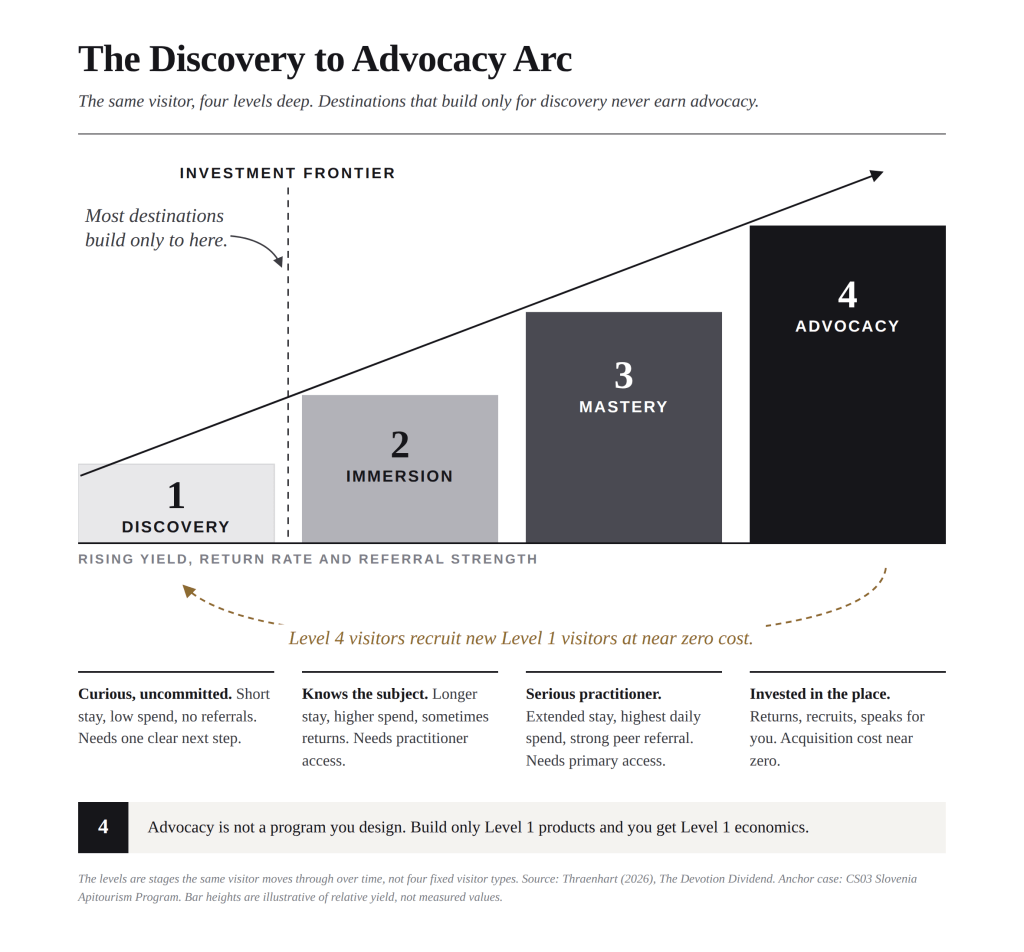
The Discovery to Advocacy Arc maps the natural progression of a passionate visitor’s engagement across four distinct levels. Each level has different characteristics, different yield profiles, and different requirements from the destination.
Level 1: Discovery
The visitor encounters the passion for the first time or encounters a new expression of a passion they already hold. The engagement is introductory. The duration is typically a half-day or single day. The commitment is low and the yield reflects that: the discovery visitor is sampling rather than investing. They spend in the range of a standard tourism product.
But discovery visitors matter for one reason that has nothing to do with their current transaction value. They are the pipeline. Discovery visitors who have a genuine encounter with an authentic version of a passion will deepen. The destination that captures the discovery visitor and provides a pathway to the next level retains that visitor’s progression. The destination that offers only discovery loses the visitor to wherever depth exists.
Level 2: Immersion
The visitor returns or extends their stay to engage more deeply. They are no longer sampling. They are learning. A multi-day workshop. An access arrangement with a practitioner. A guided expedition into the asset rather than an introduction to it. The yield at this level is substantially higher: multi-day programs, specialist guide fees, practitioner access costs. And the return rate rises sharply. A visitor who has completed an immersion-level experience has invested enough in the destination’s version of the practice that returning carries real meaning. They are not interchangeable with another destination.
Level 3: Mastery
The visitor is now pursuing serious knowledge or skill in the practice and recognizes the destination as the place where that knowledge or skill can be deepened beyond what is available elsewhere. They organize their travel calendar around the destination. They seek access to the most advanced practitioners, the most authoritative materials, the highest-level experiences. The yield at this level is the highest of any passionate visitor category. Specialist program fees, extended accommodation, access to primary knowledge holders, and equipment or material purchases specific to the practice.
This is the visitor from the Radovljica museum. They came from six countries. They already knew the terminology. They were paying for depth, not introduction.
Level 4: Advocacy
The visitor becomes part of the destination’s extended community. They recruit others. They publish. They recommend. They return to contribute, not just to consume. Some teach. Some fund conservation or preservation programs connected to the practice. The direct financial yield of the advocacy visitor may be lower than the mastery visitor because they often have reduced access costs through relationships built over time. The indirect yield is immeasurable: a practitioner-level advocate with credibility in the passionate community generates more qualified referrals than any promotional campaign reaching the same audience.
Slovenia: all four levels in one national program
Slovenia’s national apitourism program is the most complete documented example of all four levels operational at national scale.
Discovery: APILAB, the Slovenian Beekeeping Institute’s public-facing program, introduces visitors to the fundamentals of Carniolan beekeeping heritage. The entry point is accessible and does not require prior knowledge.
Immersion: the Radovljica Beekeeping Museum provides historical depth, documented heritage, and encounter with practitioners whose knowledge of the 200-year Carniolan tradition goes well beyond what any introductory program conveys.
Mastery: Slovenia’s network of forty-five certified apitourism providers offers hands-on access to beekeeping knowledge at the level the passionate enthusiast or professional beekeeper seeks. These are not tourism operators who have added bees to their menu. They are practitioners whose primary activity is beekeeping, who have met certification standards that the beekeeping community itself would recognize.
Advocacy: Slovenia’s connection to APIMONDIA, the international beekeeping community’s primary professional organization, and to World Bee Day (which Slovenia initiated and which the United Nations formally recognized) gives the advocacy-level visitor a platform and a community. The passionate beekeeper who has traveled through Slovenia’s program does not simply return home with a good experience. They carry the destination’s credibility back into an international professional network.
The revenue differential between discovery-level visitors and mastery-level visitors documented across Slovenia’s apitourism program is substantial. The mastery visitor’s contribution to the destination’s economy is not simply higher per visit. Their lifetime value through repeat visits, extended programs, and referrals to other mastery-level practitioners within the global beekeeping community is the economic asset that makes the investment in depth worthwhile.
Designing inevitable advancement
The arc does not work automatically. Visitors deepen if the pathway is clear and the next level is accessible. They plateau or leave if the pathway is unclear or if the depth they seek is unavailable at the destination.
This means product architecture matters as much as product quality. A destination that offers excellent discovery experiences but no documented pathway to immersion will lose visitors to their natural progression. The discovery visitor who asks “what would I need to do to go deeper?” and receives no clear answer does not remain at discovery level. They find depth elsewhere.
Designing for inevitable advancement means three things.
First, every experience at each level must make the next level visible and attractive. The discovery visitor should encounter evidence of what depth looks like and understand how to reach it. Not a sales pitch. Evidence: the master practitioner visible during the discovery experience, the documentation of what the advanced program involves, the community of mastery visitors whose presence communicates that depth is real here.
Second, the access points to each level must be specific and bookable. “We can arrange something more advanced” is not a pathway. A certified practitioner contact list, a documented advanced program with a specific price and availability calendar, and a booking process that works are the minimum requirements.
Third, the depth must be genuine. Discovery visitors who advance to immersion and find that the “deeper” experience is simply a longer version of the discovery experience will not advance to mastery. The depth must be substantively different at each level, not just more expensive.
The economic logic
Tourism economics is largely built around the transaction: one visit, one yield. The Discovery to Advocacy Arc is built around the relationship: a visitor’s engagement deepening over years, each level generating higher yield and higher referral quality than the one before.
The math changes substantially when you measure lifetime value rather than per-visit yield. A discovery visitor who returns annually, progressing through immersion and mastery over four or five years, generates ten to twenty times the total economic contribution of a discovery visitor who visits once and does not return. The community of advocacy visitors who recruit at the mastery level generates bookings without promotional spend.
Destination strategies that focus exclusively on attracting new discovery visitors at scale will always face pressure on margins and return rates, because discovery visitors are the least differentiated category. Any destination can offer an introduction. The destination that offers depth has a competitive position that is built over years and cannot be replicated quickly.
The Radovljica museum visitors who flew from six countries knew what depth looked like. They had seen enough at discovery level elsewhere to know when mastery was available. Slovenia built for them. That is why they came.
Dr. Jens Thraenhart is the founder of Destinspire and CEO of Chameleon Strategies. The Discovery to Advocacy Arc and the Transformation Pyramid are introduced in Chapters 5 and 7 of his forthcoming book The Devotion Dividend, Book 1 of The Passion-Tourism Economy series, publishing in late 2026. Passion community profiles, destination case studies, and the Passion Tourism Strategy Workbook are available at Destinspire.com.


Leave a Reply