
By Dr. Jens Thraenhart
A tourism board director once pulled me aside after a presentation and asked a question I have heard dozens of times since. “Everything you’re describing makes sense. But where do we actually start?”
It is the right question. Most destination strategies fail not because the vision is wrong but because the sequence is wrong. Teams skip the hard early work, rush into product development, launch campaigns before the product is ready, and then wonder why passionate visitors do not return.
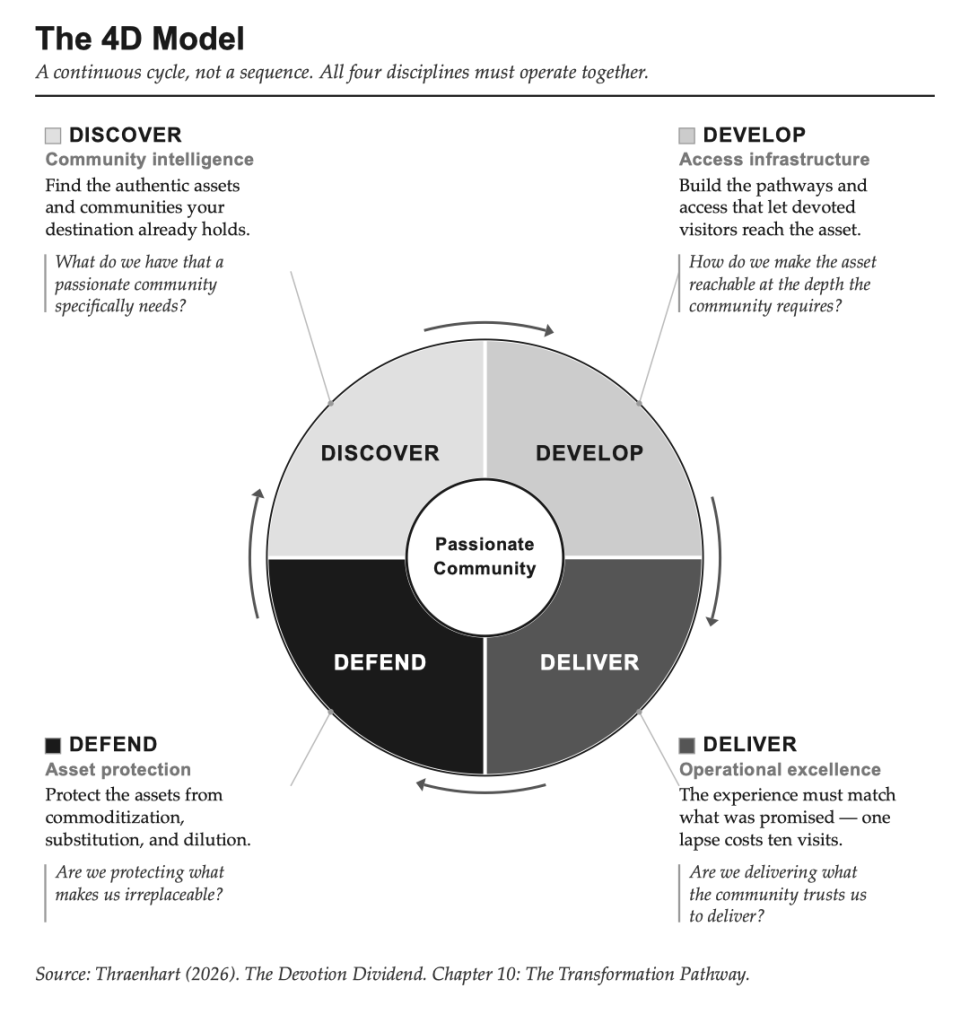
The 4D Model was developed to solve that sequencing problem. It gives destination teams a continuous pathway from asset discovery through to active protection. The four stages are Discover, Develop, Deliver, and Defend. Each one builds on the last. None can be skipped.
Why Most Passion Tourism Strategies Stall
I have worked with destinations across six continents. The failure pattern is consistent. A tourism board identifies an emerging passion community, commits resources to serve it, launches a product before understanding what the community actually needs, and sees early visitors arrive and not come back. The instinct is to spend more on marketing. The real problem is that the foundation was never built.
Passionate travelers are not forgiving. A birdwatcher who travels to a destination specifically for a documented species and finds no certified guide with real field knowledge will not return. They will also tell every birdwatcher they know. The community’s communication channels move faster and more honestly than any promotional campaign.
The 4D Model forces the correct sequence. You cannot deliver what you have not developed. You cannot develop what you have not discovered. And you cannot protect what you have not yet delivered with enough consistency to be worth protecting.
Discover: Start With What You Actually Have
The first stage is an honest audit. Not of what you wish you had. Not of what competitors have built. Of what genuinely exists in your destination that a specific passionate community would travel specifically for.
Most destinations skip this step or rush it. They arrive at a product concept before they have verified whether the underlying asset is real and whether a tribe actually cares about it.
Discover involves three actions.
First, asset mapping at a specific level. Not “we have beautiful nature.” The specific question is: what exists here that exists nowhere else, or that we do at a level nobody else matches? The answer might be a particular geological feature, a craft tradition documented to a specific community, a species population, or a practice that has been continuous for generations. The specificity matters because passionate communities are already experts. They know what is genuine. They will find you out within the first hour of arrival if you are presenting a generic version of something they know deeply.
Second, tribal verification. Before building anything, confirm that a real community organizes around this asset. The Four-Question Tribe Test helps here. Ask: what does the community call itself? Where does it gather, physically and online? How large is the devoted core, the people who would actually travel for this? And how does the community decide where to go? If you cannot answer these four questions, you do not yet know your tribe.
Third, economic modeling. What would members of this community spend if they found what they were looking for? What do comparable passion visitors spend in destinations that serve them well? This gives you a revenue baseline before you invest in development.
In Mongolia, the question my colleagues at GIZ and the Ministry of Environment and Tourism asked in Ulaanbaatar in 2019 was deceptively simple. What does Mongolia offer that no other destination on earth can replicate? The answer was not scenery. It was a way of living that the modern world has largely lost, accessible through a passionate community already organizing around dark skies and nomadic heritage. That discovery changed the entire strategic direction.
Develop: Build What the Tribe Actually Needs
Once you know what you have and who wants it, you can build. Not before.
Develop means designing the experience architecture that converts a first-time passionate visitor into a returning one, and eventually an advocate. This involves the physical product, the guide layer, the access system, and the pricing structure.
The most common mistake at this stage is building for the wrong level of engagement. Passionate visitors self-select into different depths of experience. Some are discovering the passion for the first time. Others are already practitioners with years of knowledge who want to go deeper than anything they have done before. A destination that builds only for beginners will lose advanced visitors immediately. A destination that builds only for advanced visitors will have a very small market.
The progression pathway matters. What does a first encounter look like? What does a mastery-level experience look like? And what are the steps between? Each level needs to be designed intentionally, with pricing that reflects the depth of access rather than the cost of delivery.
Practitioners, guides, and local knowledge holders are the foundation. Without them, the product has no credibility with the community you are trying to serve. Building strong relationships with these people before you open to visitors is not optional. It is the product.
Deliver: Reach the Right People Through the Right Channels
The third stage is often misunderstood as marketing. It is more specific than that. Deliver means reaching the passionate community through the channels it already trusts, with the message that matters to it.
Passionate communities do not respond to mass advertising. They respond to peer recommendation, practitioner endorsement, and documentation. A certified guide with a strong reputation in the fly fishing community will fill beats through word of mouth. A press release to general travel media will not.
Find out where your tribe gathers. Not where tourists gather. Where practitioners and enthusiasts gather. The annual conference, the specialist forum, the publication read by the community’s most committed members, the operator whose clients are already pre-selected for this passion. Reach the community through those channels first. Your marketing budget goes further and reaches people who actually come.
Ambassador recruitment is part of Deliver. The passionate visitor who had an exceptional experience and is already connected to the tribe is your most effective channel. Design the experience so that documentation and sharing are natural outcomes of the visit. Practitioners share what they discover. Give them something worth sharing.
Defend: Protect What You Have Built
The fourth stage is where most destinations fail to invest, because by the time they reach it, the program appears to be working and the pressure to maintain it feels lower than the pressure to grow.
Defend means protecting the quality, the community relationship, and the asset itself. It means standards enforcement so that the experience visitors receive in year five is at least as good as the experience in year one. It means geographic indication or certification systems when the asset is replicable enough to attract imitators. And it means crisis preparedness built on the community depth you have developed.
Passionate communities offer protection that money cannot buy. If the asset comes under threat, whether from environmental pressure, competitive dilution, or commercial drift toward performance over authenticity, a deeply committed community will often notice before your team does and respond before you ask them to.
Shaolin Temple in China shows what happens when Defend is skipped. A heritage of genuine martial practice was gradually replaced by commercial performance. The practitioners who had traveled specifically for the authentic encounter stopped coming. Recovery has proven extremely difficult over more than fifteen years. The lesson is not unique to Shaolin. It is the most common failure mode in passion tourism.
Slovenia: The 4D Model in Practice
Slovenia’s apitourism program is the most complete example of all four stages operational at national scale.
Discover: the Ministry of Tourism and the Slovenian Beekeeping Association identified a 200-year tradition of Carniolan beekeeping as an asset with genuine irreplaceability. No other country has this heritage at this depth, with this level of practitioner continuity.
Develop: APILAB was built as the discovery layer. Certified apitourism providers, now numbering 45, were developed as the practitioner layer. The Radovljica Beekeeping Museum provided the heritage context. Each level of engagement was designed for a different depth of passion.
Deliver: Slovenia connected its program to the APIMONDIA network, the international beekeeping community’s primary professional structure. The 2023 APIMONDIA congress in Santiago drew 3,800 professionals from 120 countries. These are not general tourists. They are practitioners who organize their international travel around beekeeping heritage. Slovenia positioned itself as the mandatory destination for this community.
Defend: EU quality certification for Carniolan bees and apitourism products created a verifiable standard that protects the program against imitation and dilution. World Bee Day, which Slovenia initiated and which the United Nations formally recognized, gives the program a permanent international platform.
The result, documented across the program, is that visitors who engage at the deepest levels generate dramatically higher revenue than visitors who make a single discovery-level visit. The progression pathway architecture, not a marketing campaign, drives that difference.
Where to Start
The 4D Model is a continuous cycle, not a one-time exercise. A destination that has been delivering for years still needs to invest in Discover to stay current with how the passionate community is evolving. A destination at Defend still needs to ensure it is reaching new members of the community who do not know it yet.
If you are starting from scratch, begin with Discover. Reserve two months for an honest asset audit at the specific level. Do not skip to product design. Do not commit to a target community before you have verified the asset.
If you are partway through and stalled, diagnose which stage you are actually at. Most teams that think they are at Deliver have not completed Develop. Most teams that think they are at Defend are still managing quality problems from an incomplete Deliver.
The 4D Model does not promise speed. It promises that the destination you build will still be operating and still serving passionate visitors ten years from now. That is what a tourism strategy is for.
Dr. Jens Thraenhart is the founder of Destinspire and CEO of Chameleon Strategies. The 4D Model is introduced in full in his forthcoming book The Devotion Dividend, Book 1 of The Passion-Tourism Economy series, publishing in late 2026. Case studies, destination profiles, and passion tourism innovation catalogues are available at Destinspire.com.
 BALANCED TOURISM
Leave a comment