
By Dr. Jens Thraenhart
The failure pattern is consistent enough that I can describe it before arriving at the destination.
A tourism team identifies a genuine passion community and a genuine local tradition. They build an experience. They launch it. The first passionate visitors arrive, evaluate it within the first thirty minutes, and leave disappointed. Within weeks, the community’s forums and specialist publications carry warnings. Bookings from that community drop. The team blames the marketing. The real problem was built into the product before it launched.
Passionate travelers are not forgiving evaluators. A serious textile collector can identify synthetic dyes in block printing within seconds of watching the process. A devoted sake producer can detect a shortcut in fermentation within the first conversation with the guide. A conservation-committed wildlife traveler knows within the first briefing whether the ranger genuinely understands the species or has memorized talking points. Passionate visitors have spent thousands of hours developing expertise in their field. You cannot disguise a compromised product from them, and trying to do so is worse than not launching at all.
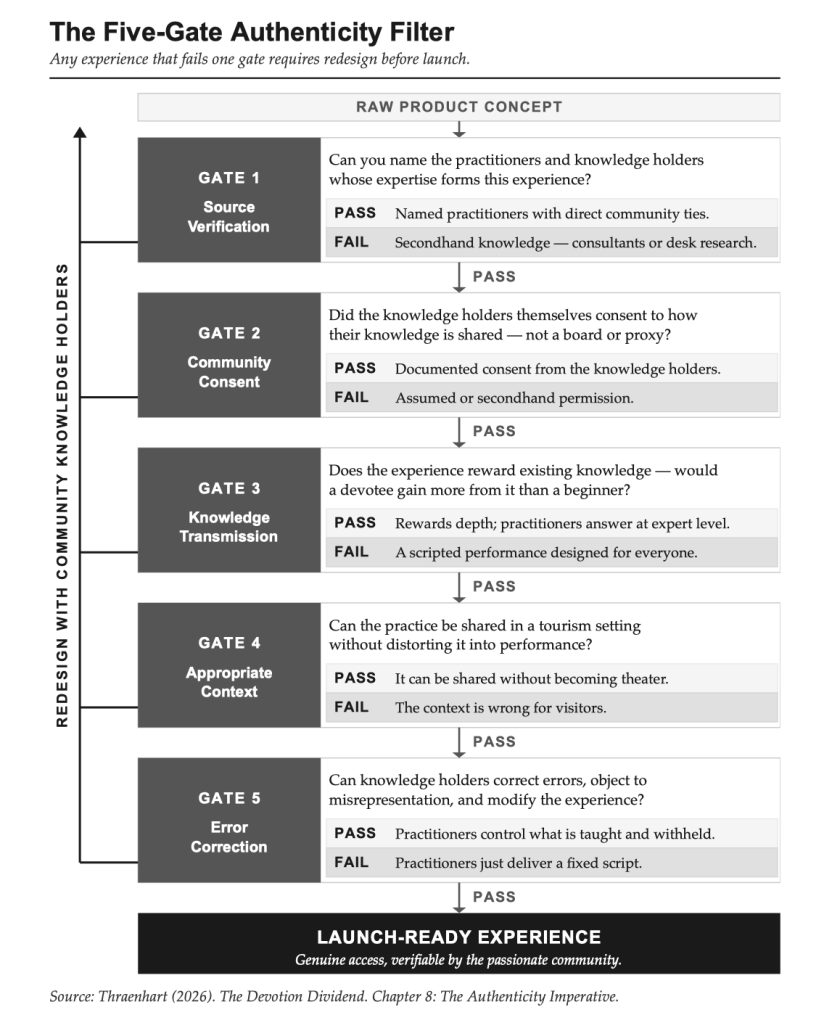
The Five-Gate Authenticity Filter is a pre-launch diagnostic tool. Its purpose is to identify authenticity problems before the passionate community does. Each gate represents a category of risk that, if unaddressed, will produce a detectable failure when the right visitor arrives. Fail any single gate and the product is not ready.
Why the community always finds out
Passionate communities communicate faster and more honestly than any promotional channel. One experienced practitioner who detects an authenticity failure will share that observation with the five or ten people who trust their judgment most. Those people tell others. Within weeks, the specialist forums that the community actually reads carry a warning. Future visitors from that community cancel or never book.
The reverse is equally true. One genuine experience, communicated honestly to the right practitioner, cascades outward through the community in the same way. The forum post that says “this is the real thing” generates more qualified bookings than any promotional campaign reaching the same audience.
What this means for destination managers is that authenticity is not a differentiator. It is a threshold. Below it, the passionate community will not come. Above it, word of mouth does most of the work. The Five-Gate Filter tells you where you stand before you open to the community whose verdict is permanent.
Gate 1: Source Verification
The first gate asks a simple question: can a named, acknowledged practitioner from the passion community verify that this is how the practice is actually done?
Not a representative. Not an administrator. Not someone who has studied the practice from the outside. A practitioner whose credentials the community would recognize.
In Rajasthan in 2017, I observed block printing demonstrations in which synthetic dyes had replaced the traditional mordanting process that gives Bagru block printing its specific color characteristics. From a distance, the demonstration looked identical. To a textile collector who had studied natural dye processes, the absence of the mordanting steps was immediately visible. The practitioners knew. The tourism operators had made a compromise that seemed commercially logical and that destroyed the experience for the only visitors who had traveled specifically for it.
The Chhipa community’s mordanting knowledge exists in no published source. It lives in practiced hands. A named Chhipa master printer examining the demonstration would have identified the failure within minutes. That is Gate 1: the knowledge holder exists, is accessible, and would confirm what you are offering is genuine.
If you cannot name the practitioner who reviewed and endorsed the experience before launch, the first gate is not yet passed.
Gate 2: Community Consent
The second gate asks whether the community whose culture or practice is being presented has genuinely agreed to how it is being presented. Not a government ministry on their behalf. Not a heritage body that administers the tradition from outside. The practitioners themselves.
This distinction matters because the people who typically consent to a cultural tourism product on behalf of a community are often not the people whose practice is being shown. A tourism board official, a cultural heritage administrator, or even a community leader may sign off on a product that the practitioners themselves regard as a misrepresentation of their work.
When the Consorzio Promovetro Maestro Vetraio certification was established in Murano, Italy, to protect the identity of authentic Venetian glassblowing, the critical design decision was that the certification would be governed by the maestri themselves. Not by the island’s tourism authority. Not by the regional government. The people whose craft was being certified controlled the standards for certification. That governance structure is what gave the Maestro Vetraio designation its credibility with serious collectors, who knew that the people setting the standards were the same people whose work met them.
Community consent that passes Gate 2 is documented, specific, and comes from practitioners. It specifies what is being shown, to whom, in what context, and under what conditions.
Gate 3: Knowledge Transmission
The third gate asks whether the experience genuinely transmits knowledge. Does a visitor leave knowing something real about the practice that they did not know before arriving?
This gate is failed most often when products are simplified for general audiences without recognizing that the passionate visitor is not a general audience. A passionate visitor who has spent years studying a craft, a cultural practice, or a natural system does not need an introduction to the subject. They need an encounter with a depth of knowledge they cannot access from where they are. A simplified version of what they already know is not only unhelpful. It is a signal that the product was designed for someone else.
The scholar mode visitor attending En Primeur barrel tastings in Bordeaux is not there for an introduction to how wine is made. They are there because the winemaker will tell them things about this specific vintage, this specific decision, this specific growing season that no published critic’s note contains. That is knowledge transmission. The experience advances understanding at the frontier of what the visitor already knows.
A destination that launches a block printing experience showing only the printing stage, omitting the mordanting, dyeing, and washing processes that a serious textile practitioner needs to understand, has failed Gate 3. Not because the simplified version is wrong. Because the simplified version is not what the passionate visitor came for.
Gate 4: Appropriate Context
The fourth gate asks whether the experience is presented in a setting and format that the practice itself would recognize as legitimate.
Would a senior practitioner from the passionate community be comfortable watching a visitor participate in this experience? Not comfortable in a general sense. Comfortable that the setting, the framing, the pace, the level of knowledge assumed, and the physical environment are consistent with how the practice actually lives.
Capoeira practiced on a stage in a hotel lobby for an audience seated at dinner tables has failed Gate 4. The roda requires a specific spatial relationship between participants and audience, specific music at specific tempos, and a specific understanding of what is being witnessed. Removing those elements turns the practice into a performance. The capoeira practitioner watching from the audience knows immediately.
Tea ceremony conducted in fifteen minutes for a tourist group that has been told to take photos throughout has failed Gate 4. The practice requires a pace, a spatial arrangement, and an attention economy that fifteen minutes with cameras does not accommodate.
Gate 4 is often failed not through malice but through accommodation: the product was adapted to fit a time slot, a venue, or an audience assumption that was not designed around the practice. The question is always whether a practitioner watching would recognize what they are seeing as theirs.
Gate 5: Error Correction
The fifth gate asks whether there is a functioning mechanism for the community to identify and correct problems. Who can flag an error, and how quickly does it get addressed?
This is the gate most frequently omitted in product design because it requires acknowledging that the product might be wrong in ways that become visible only after launch. But it is the gate that protects the ongoing relationship with the community.
Passionate communities change. Practices evolve. Knowledge holders retire or move. What was accurate at launch may drift over time. Gate 5 ensures that the product stays accurate because the people who can identify errors have a direct line to the people who can fix them.
A craft heritage experience where the practitioner teaching the workshop has no mechanism to tell the tour operator that a new guide is misrepresenting the technique will drift toward inaccuracy within months. A wildlife experience where the ranger who identifies an ecological error in the briefing materials has no path to correcting them will compound that error across every future visitor group.
The error correction mechanism needs to be specific, named, and fast. The practitioner or community member who identifies a problem needs to know who to call, be confident that the call will result in action, and see the correction made within days rather than weeks.
Applying the filter before launch
The Five-Gate Filter is most powerful when applied before any marketing investment in a new passion tourism product. Run through all five gates with a practitioner from the relevant community before the first visitor is booked.
Gate 1: Who is the named practitioner who has reviewed this experience and would publicly confirm it is authentic?
Gate 2: What documentation exists of genuine community consent, and which practitioners gave it?
Gate 3: What specific knowledge does a visitor gain that they did not have before arriving? Would an experienced community member regard that knowledge as substantive?
Gate 4: Would a senior practitioner watching this experience recognize it as consistent with how the practice actually lives?
Gate 5: Who is the named person a practitioner calls if they identify a problem, and what is the committed response time?
If any gate cannot be answered specifically, the product is not ready. More time spent before launch is less damage than a single reputation cascade after it.
The positive case
Murano’s Maestro Vetraio certification did not save a failing industry by improving marketing. It saved a failing industry by making authentic work identifiable through governance that the community of masters controlled. A serious collector standing in front of a piece of Murano glass marked with the Maestro Vetraio designation knows that the practitioner community itself certified the maker. That signal carries more information than any promotional claim could convey, because it comes from the only source the community trusts.
That is what passing all five gates produces. Not a marketing claim about authenticity. A product that the community’s most credible members can endorse with their own reputations.
Dr. Jens Thraenhart is the founder of Destinspire and CEO of Chameleon Strategies. The Five-Gate Authenticity Filter is developed in full in Chapter 8 of his forthcoming book The Devotion Dividend, Book 1 of The Passion-Tourism Economy series, publishing in late 2026. The framework is included in the Passion Tourism Strategy Workbook, available at Destinspire.com alongside destination case studies and passion community profiles.


Leave a Reply