

By Dr. Jens Thraenhart
Every passion tourism strategy eventually hits the same wall.
A destination identifies a passionate community, builds infrastructure to serve it, and attracts the right visitors. Then the feedback starts arriving. Some of those visitors say the experience was everything they hoped for. Others, with identical passion credentials and identical demographic profiles, say it missed them entirely. The product did not change. The community was the right one. What went wrong?
Most of the time, nothing went wrong with the product. The problem is that the destination built for one way of being a passionate visitor and served four.
Passionate travelers do not all engage with a destination in the same way. Two people with identical, genuine, deep commitment to the same passion may need completely different things from the same destination. One comes to practice. One comes to witness. One comes because this place is where the passion began. One comes because this is where its most authoritative knowledge lives. These are not preferences. They are fundamentally different modes of engagement, each requiring different infrastructure, different access, and different authenticity guarantees.
I developed the Four Modes of Passion Travel to give destination managers a framework for identifying which mode their visitors are in and what that mode actually requires. The framework is the basis of Chapter 6 of The Devotion Dividend and is one of the book’s core contributions to destination strategy. But the concept is practical enough to apply immediately, before the book arrives.
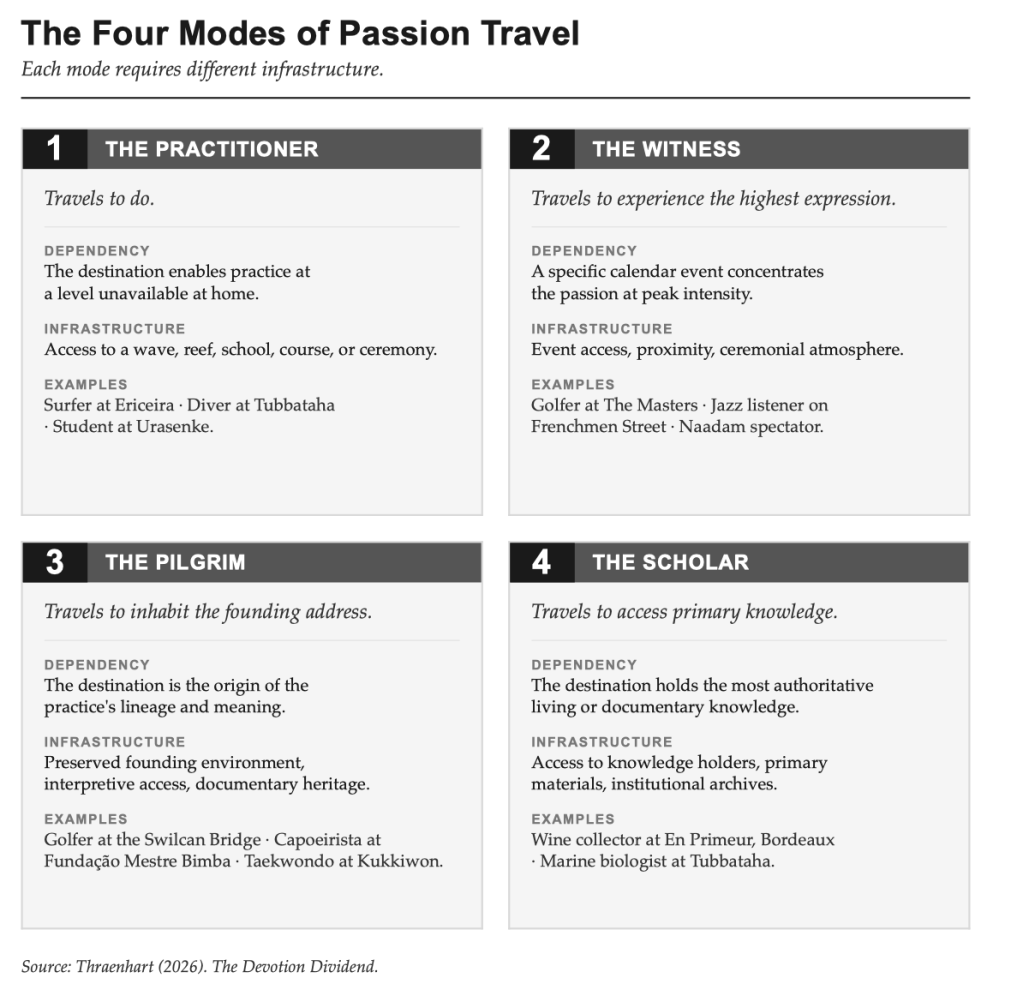
Mode 1: The Practitioner
The practitioner travels because this destination enables practice at a level that is unavailable at home.
The dependency is clear. The practitioner needs the specific thing their passion requires: the wave, the reef, the school, the mestre, the kiln, the instrument, the teacher, the conditions. They are not there to observe. They are there to do the thing. And the destination’s claim to their attention rests entirely on whether it offers practice conditions, access, or expertise that they cannot find elsewhere.
A serious capoeira practitioner who travels to Salvador da Bahia is a practitioner. The Mestre who teaches them is not available elsewhere at the same level of lineage and authority. The roda environment cannot be replicated in a studio in another city. The practitioner’s yield is typically the highest of any mode: they commit time, they pay for lessons and access, they stay as long as the practice demands, and they return when the practice calls them back.
The astrophotographer who books a permit at a research observatory in the Atacama is a practitioner. The dark sky quality, the altitude, the air stability, and in some cases the proximity to professional scientific infrastructure are the specific conditions the practice requires. They bring equipment worth more than many people’s annual salary. They stay for the conditions, not the region.
The chalk stream fly fisher who secures a day ticket on the River Test in Hampshire is a practitioner. Frederic Halford developed the upstream dry fly technique on these waters. The ranunculus beds, the chalk stream clarity, the wild brown trout density, and the specific heritage of the beats are all part of what the practitioner has come to access. A stocked river elsewhere does not substitute.
In each case, the practitioner infrastructure is specific and non-generic. You cannot build for chalk stream fly fishing by building a fishing pond. You cannot build for capoeira by offering a martial arts class. The specificity of the practice requirement is what defines the mode and what gives the destination its competitive moat.
Mode 2: The Witness
The witness travels to experience the passion at its highest or most specific expression. They are not practicing. They are present for something that happens here, at this time, at a level that cannot be replicated elsewhere.
The witness mode’s defining characteristic is calendar concentration. A peak expression of a passion, occurring at a specific location during a specific window of time, generates demand among witnesses that no other product at that destination generates at any other moment. And the passionate witness has typically planned for this window months or years in advance.
The Masters badge holder at Augusta National is a witness. They are not there to play golf. They are there to be present for what many in the golf community regard as the sport’s most ritually specific annual expression. The gates, the grounds, the specific traditions of the event, the azaleas in bloom: these constitute a witness experience whose calendar irreplaceability drives demand that no accommodation pricing comparison can temper.
The New Orleans Jazz Festival attendee who plans their trip around a specific performer on a specific stage on a specific Saturday is a witness. The Jazz Fest’s density of documented musical lineage per square meter, concentrated into a specific week in April and early May, is what makes it a witness event rather than a general music festival. The passionate listener who comes specifically for a late-career performance by a musician who has been part of the New Orleans scene for forty years is not interchangeable with a general festival visitor.
The Naadam spectator who travels to Mongolia for the wrestling, archery, and horsemanship competition in July is a witness. The Naadam concentrates practices rooted in Mongolian culture across a specific calendar window, in a specific geographical and ceremonial context, with a cultural weight that no performance for tourists carries. The passionate witness knows the history of the Three Games of Men. They come for that.
Yield optimization for the witness mode is different from practitioner optimization. The practitioner’s yield comes from session fees, extended stay, and repeat visits tied to practice improvement. The witness’s yield comes from the event window itself, compressed and intense. Destination managers who understand this can price accommodation, event access, and related experiences to reflect the irreplaceability of the window rather than comparing to off-season rates.
Mode 3: The Pilgrim
The pilgrim travels to inhabit the founding address of their passion’s lineage and meaning. They are not primarily there to practice. They are not there to witness a specific event. They are there because this is where the thing began, or where the thing was codified, or where it carries institutional authority that no other address carries.
The passionate golfer who crosses the Swilcan Bridge on the Old Course at St Andrews is, in that moment, a pilgrim. They may also be a practitioner, booking a ballot tee time to actually play the course. But the act of crossing that specific bridge, on that specific course, connects them to a lineage of golf that has run continuously through that place for centuries. The bridge is infrastructure for the pilgrim mode, as surely as the tee box is infrastructure for the practitioner mode.
The capoeira practitioner who visits the Fundacao Mestre Bimba in the Pelourinho district of Salvador is a pilgrim. Mestre Bimba codified Capoeira Regional in that specific environment. Its UNESCO recognition as Intangible Cultural Heritage of Humanity acknowledges the lineage that runs from there. The practitioner who travels to study capoeira in Salvador may also spend time at the Fundacao not to improve their ginga but to make contact with the source. That visit serves the pilgrim mode.
The Barbados rum heritage traveler who seeks out the Three Houses estate site, where the agricultural history of Caribbean rum production is physically rooted, is on a pilgrimage. Not to taste rum. To stand where the history happened.
Pilgrim infrastructure is primarily spatial and interpretive. Preserved founding environments. Documentary access to institutional heritage. Freedom to move through the space at the pilgrim’s pace. The pilgrim is not there for a guided tour of what happened somewhere else. They are there because here is the place. The infrastructure that serves them is the one that makes here feel genuinely like here, rather than a reconstruction or a simulation.
Mode 4: The Scholar
The scholar travels because the destination holds the most authoritative living or documentary knowledge of their passion, and proximity to that knowledge advances their understanding in ways that no secondary source can replicate.
The passionate wine collector who travels to Bordeaux for En Primeur barrel tastings in April is primarily a scholar. They taste from barrel under the guidance of the winemaker and the maître de chai. They ask specific questions about vintage conditions, blending decisions, and the anticipated development arc over fifteen to twenty years. That knowledge exists nowhere else at that moment. No published critic’s note provides it. The dialogue between the passionate collector and the person who made the wine, in the cellar where the wine is still becoming what it will be, is the experience. And it is available only there, only then, only through that access.
The marine biologist who books a dive research permit at Tubbataha Reef in the Sulu Sea is partly a practitioner and partly a scholar. They seek access to a reef ecosystem whose documentation and management by the Tubbataha Management Office represents the most authoritative knowledge of that specific environment available anywhere. Proximity to the people who manage and research that reef advances understanding of reef ecology in ways that no published paper fully substitutes.
The scholar mode is strongest wherever a passion involves a body of knowledge whose most authoritative holders are physically located at the destination. Kyoto’s tea ceremony masters hold a depth of understanding of chado that cannot be transferred to any other city. The traditional Mongolian wrestling masters who can explain the tactical vocabulary of Bökh from within the practice are on the steppe in July. In each case, the scholar’s dependency is on proximity to the knowledge holder, not simply on the environment.
Why most destinations build for one mode and miss three
The practitioner mode is the easiest to identify and the easiest to build for. Surf schools for surf destinations. Practice facilities for golf destinations. Tasting rooms for wine destinations. That infrastructure is real and serves the practitioner correctly.
The witness, pilgrim, and scholar modes require different things and generate different yield profiles. Building for them requires asking what each mode actually needs rather than defaulting to practitioner infrastructure.
This matters most when a destination’s most committed and highest-yield visitors are not primarily practitioners. Augusta National’s highest-value visitors during Masters week are witnesses. The R&A’s St Andrews visitors who seek out The R&A World Golf Museum are scholars and pilgrims. A golf destination strategy that builds only practitioner infrastructure fails to capture those visitors at the level they could be served.
More damaging is when pilgrim or scholar infrastructure is actively absent, and passionate visitors arrive expecting it. A visitor who travels to a heritage distillery as a pilgrim, wanting to stand where the tradition began and understand its institutional meaning, and finds only a commercial tasting room and a retail shop, has not found what they came for. They leave. They do not refer. And they tell other community members that the destination treated them as consumers rather than as serious members of the tradition.
One destination, four modes, distinct infrastructure
The destination that gets this right serves all four modes without confusing them.
St Andrews is the most complete example in global tourism. The Old Course ballot system serves the practitioner: a democratic, below-market-rate allocation of tee times on the course where the game was codified, designed to preserve practitioner access as a heritage commitment. The Open Championship serves the witness: one week every few years when the Old Course concentrates the sport’s most ritually significant competitive event. The R&A World Golf Museum serves the scholar: primary documentary access to the game’s institutional history, equipment, records, and the written heritage that has accumulated since the rules were first codified. The Swilcan Bridge walking access serves the pilgrim: the freedom to cross the bridge, to stand on the hole, to make physical contact with a place whose meaning to the golf community exceeds anything that can be fully explained to someone outside it.
These four modes share an address. They do not share a product. The pilgrim crossing the bridge has no interest in booking a tee time that afternoon. The scholar in the museum has no interest in the leaderboard. The witness in the grandstand on the 18th hole during the Open has no interest in a guided tour of the clubhouse archives. Distinct infrastructure, distinct access, distinct experience. Four communities, one destination.
Four questions for Monday morning
The framework translates directly into operational questions.
What does the practitioner from your primary passionate community need from this destination that they cannot find at the same level anywhere else?
What does the witness need? Is there a specific calendar event, ceremony, or seasonal concentration of the passion’s peak expression that creates witness demand? If so, is the infrastructure for that event designed for the witness experience or adapted from general tourism product?
What does the pilgrim need? Is your destination the founding address of this passion’s lineage? If it is, what access does the pilgrim have to that founding environment? Can they move through it at their own pace, on their own terms?
What does the scholar need? Who are the most authoritative knowledge holders in your destination? Are they accessible to serious visitors? Is that access designed and priced?
Each question has a different answer. Each answer implies a different infrastructure investment. The destination that answers all four correctly serves not one passionate community but four, at the same address.
Dr. Jens Thraenhart is the founder of Destinspire and CEO of Chameleon Strategies. The Four Modes of Passion Travel framework is introduced in full in Chapter 6 of his forthcoming book The Devotion Dividend, Book 1 of The Passion-Tourism Economy series, publishing in late 2026. Passion community profiles, destination case studies, and implementation resources are available at Destinspire.com.
 BALANCED TOURISM
Leave a comment