
By Dr. Jens Thraenhart
In 2020, I was reviewing a destination’s marketing strategy. The team had spent eighteen months building what they called persona documents. Detailed profiles. Demographics. Psychographics. Travel behaviors. Income levels. Media consumption habits.
One persona was named Sarah. Thirty-four years old. Marketing manager. Earns USD 85,000 a year. Reads travel blogs. Follows Instagram influencers. Interested in authentic experiences and sustainable travel.
I asked one question. Where does Sarah actually exist?
Silence.
Where is her community? What forums does she read? Which events does she attend? When you search for people like Sarah, where do you find them?
They could not answer. Sarah was a fiction. A composite built from survey data and demographic research. She represented millions of people theoretically. But you could not actually find her anywhere. You could not reach her through any specific channel. You could not speak her language because she did not have one.
I have seen this problem across dozens of destinations on six continents. Teams invest in communities that do not exist. They design products for demographics rather than tribes. They launch campaigns into the void and wonder why the conversion rate is so low.
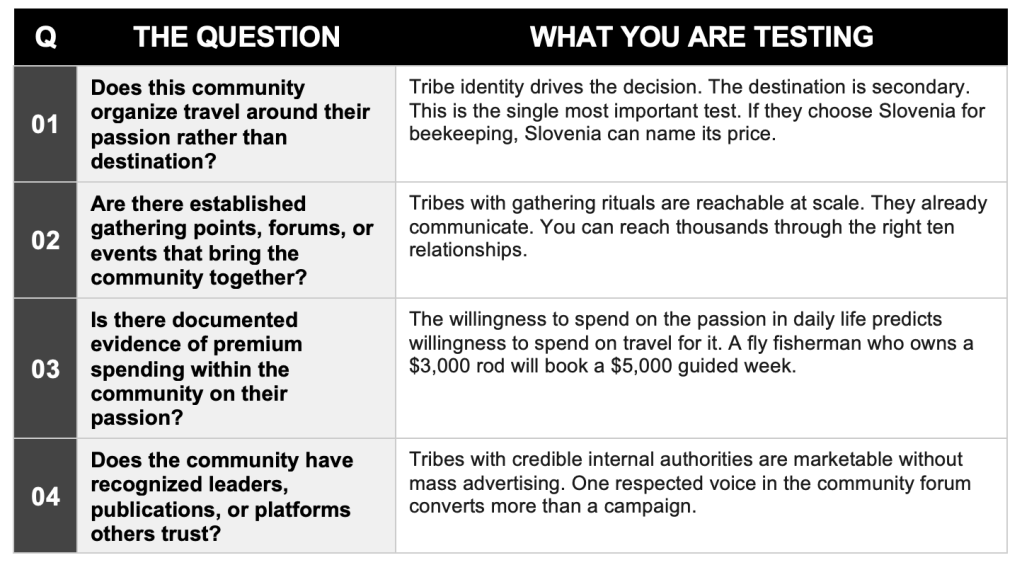
The Four-Question Tribe Test was developed to stop that from happening.
Demographics describe categories. Tribes have identities.
A demographic is a statistical category. “Women aged 25 to 34 with an interest in wellness travel” is a demographic. You can find that number in a survey. You cannot find those women in a room, because there is no room they all go to.
A tribe is different. A tribe calls itself something. It gathers in specific places. Its members recognize each other within minutes of conversation. They share vocabulary, values, reference points, and standards that outsiders do not have.
Traditional fermentation practitioners who travel to study regional variations. They organize through Koji community forums. They gather at NOMA alumni networks and academic food science conferences. They use technical language that distinguishes them from people who are simply interested in food. There are roughly thirty thousand of them globally. You can find them. You can reach them. You can speak their language.
That is the difference. A demographic is something you describe. A tribe is something you find.
The Four-Question Tribe Test tells you which one you are actually dealing with.
Question 1: What does the community call itself?
A real tribe names itself. The name it uses is different from the name outsiders use to describe it.
Birdwatchers do not call themselves birdwatchers. They call themselves birders. The distinction matters to the community. Birdwatcher implies passive observation. Birder implies active, committed pursuit. A serious member of this community will correct you if you use the wrong word. That correction tells you something.
Whisky travelers call themselves aficionados, enthusiasts, or by specific community names tied to their preferred spirit category. Scotch aficionados use different language from bourbon lovers. They have different forums, different reference authorities, different travel drivers.
Dry fly fishers call themselves chalk stream anglers when they are in Hampshire. They call themselves limestone stream anglers when they are in Slovenia. The specific name changes with the geography. The underlying identity does not.
If you cannot name the community the way its members name themselves, you do not know the community yet. And if you cannot find any name the community uses for itself, you may be looking at a demographic rather than a tribe.
Question 2: Where does the tribe gather, physically and digitally?
Real tribes have specific gathering places. They are not spread evenly across the general internet. They concentrate.
The global astrophotography community gathers on Astrobin and in dedicated subreddits where members share long-exposure images and compare equipment. They attend the Texas Star Party in the Davis Mountains and the Deep Sky Chile Star Party in the Atacama. They cite specific Bortle-scale dark sky ratings when discussing potential destinations. If you cannot identify three places online where this community concentrates and two annual events where members gather in person, you do not yet know where this tribe lives.
During my time at the Mekong Tourism Coordinating Office, we worked to map the traditional textile community across six countries. The initial estimate was fifty thousand people. When we started identifying actual gathering places, including specialist museums, guild associations, natural dye practitioner networks, and specific craft fairs attended by serious collectors, the mapped network exceeded three hundred thousand. The community was larger than anyone had estimated because nobody had looked for it where it actually lived.
The gathering places answer a second question at the same time. They tell you which channels to use when you want to reach the community. You do not advertise to chalk stream fly fishers on Instagram. You reach them through Trout and Salmon magazine, through the Flyfishers’ Club in London, and through the river keepers whose social posts document specific hatches on specific beats. These are the channels the community trusts. Anything outside them is noise.
Question 3: How large is the devoted core, and how committed are its members?
Community size alone is not the measure. What matters is the devoted core. The members who organize their international travel around the passion, who spend significantly above average, and who return repeatedly.
At Destination Canada from 2005 to 2008, we built one of the first CRM systems for tribal tracking in national tourism. The data was striking. Fifteen percent of visitors generated forty-seven percent of retained revenue. Those fifteen percent were the passionate tribes. The other eighty-five percent were volume. Every destination has this distribution. Most cannot see it because their measurement systems track arrivals, not community depth.
The committed core is what you are building for. And the size of that core tells you the economic potential of the investment.
Dark sky astrophotographers number around two hundred thousand globally, based on participation in eBird equivalent platforms and equipment community forums. They travel specifically for dark skies. They invest between five thousand and fifty thousand US dollars in equipment. They plan trips around Bortle Class 1 and 2 sites that are accessible and well-documented. A destination that genuinely serves this community does not need to reach the casual astronomer. The committed core justifies the investment and recruits its own cohort.
The warning sign is when community size is estimated from demographic data rather than participation. “Travelers interested in food” is a very large category. “Traditional fermentation practitioners who travel to study regional variations” is a much smaller community, perhaps thirty thousand globally, but they are far more reachable, more consistent in their travel behavior, and more willing to spend at depth. Smaller and committed beats larger and diffuse every time.
Question 4: How does the tribe decide where to travel?
This is the most important question. And the answer is almost never paid advertising.
Passionate communities make destination decisions through peer validation, practitioner recommendation, and documented evidence. They rely on people who share their specific knowledge and standards, not on general travel media.
A birdwatcher does not choose Costa Rica because of a tourism board campaign. They choose Costa Rica because eBird shows 940 documented species across five distinct habitat zones, because the Resplendent Quetzal is reliably sighted at San Gerardo de Dota during breeding season, and because Field Guides and Victor Emanuel Nature Tours put it on their departure schedules. Those specialist operators carry credibility with the community that no advertising budget can replicate.
A serious fly fisher does not choose Hampshire from a search result. They choose it because a river keeper they follow on social media documented a specific mayfly hatch on a specific Test beat, because another fly fisher in their network held a permit on the Houghton Club water and confirmed the wild brown trout density, and because Frederic Halford developed the upstream dry fly method on these rivers in the 1880s and they have read his books.
Understanding how the community decides is what tells you how to reach them. Most destinations spend their marketing budget on channels the tribe ignores and skip the channels the tribe trusts.
Applying the test: what it looks like in practice
In Ulaanbaatar in 2019, during advisory work with GIZ and the Mongolian Ministry of Environment and Tourism, we applied a version of this test to dark sky and nomadic heritage tourism. The four questions forced a critical conversation. What did the dark sky community call itself? Where did it gather? How large was the devoted core willing to travel to Mongolia specifically? And how would they find out that Mongolia’s Gobi Desert offered dark skies comparable to the best sites anywhere on earth?
The answers redirected the entire strategy. The community called itself astrophotographers when equipment was the focus and dark sky travelers when the experience was the focus. It gathered on Astrobin, in astronomy society forums, and at dedicated star parties on multiple continents. The devoted travel-motivated core was substantial, and it was already discussing Mongolia in its forums before any tourism board had reached them. The destination did not need to build awareness. It needed to confirm what the community had already heard and give practitioners the documentation and access they needed to commit.
That reorientation changed which investments made sense, which channels mattered, and what the experience needed to deliver.
Warning signs the test has failed
Before committing resources to a passion community, the Four-Question Tribe Test should clear four checkpoints. If any one of them fails, stop.
If you cannot name the community the way members name themselves, you do not yet know the community.
If you cannot identify three online gathering places and two annual events where members concentrate, you have not found the tribe.
If your community size estimate comes from demographic survey data rather than participation counts, you are measuring the wrong thing.
If your plan to reach the community relies on general advertising rather than specific trusted channels, you have not answered Question 4.
The most common failure I see is the community description that requires multiple qualifiers: “eco-conscious luxury travelers seeking authentic wellness experiences.” That description does not belong to any self-organizing tribe. It is a marketing category built from overlapping demographics. Nobody identifies as an eco-conscious luxury traveler. They identify as a serious trail runner, a certified yoga teacher, a practicing Ayurveda student. Find the specific identity. The qualifiers will follow.
What the test enables
Passing all four questions does not mean the product is ready. It means you know who you are building for. That is the prerequisite for everything else.
The Four-Question Tribe Test sits at the start of the Discover stage of the 4D Model. Before you can develop a product, you need to verify the tribe is real, findable, and motivated to travel for what you have. Before you can run the first step of the 5Ps framework (Pinpoint: use the Tribe Test to identify specific passionate communities, not generic interest groups), you need the test results in hand.
The test also tells you what to build. Once you know how the community decides where to travel, what channels it trusts, and what standards it applies, you know what the product needs to deliver and where to put your communication budget.
A destination that passes the Four-Question Tribe Test and acts on the answers is already ahead of most of its competitors. Most destinations are still building for Sarah.
Dr. Jens Thraenhart is the founder of Destinspire and CEO of Chameleon Strategies. The Four-Question Tribe Test is developed in full in his forthcoming book The Devotion Dividend, Book 1 of The Passion-Tourism Economy series, publishing in late 2026. PassionExplorer.com uses AI to apply tribal identification at scale across more than 500 passion micro-niches. Case studies and destination profiles are available at Destinspire.com.


Leave a Reply