
By Dr. Jens Thraenhart
Two groups attend the same festival in the same week.
The first group joins a ninety-minute organized tour. They photograph the performances, purchase a few souvenirs, eat lunch at a nearby restaurant, and leave for their next destination. Their per-person spend is in the range of a standard cultural tourism day. Their return rate is low. Their referral rate is negligible. Most of them will have forgotten the specific name of the festival within a year.
The second group spends five days. They participate in hands-on workshops with master practitioners. They join ceremonial preparations. They eat with local families. They learn enough vocabulary to understand what they are watching. By the end of the week, several of them have made arrangements to return with friends who share the same interest. One member of the group, over the following nine years, organizes annual visits that bring fifteen or more people each time.
Same festival. Same week. The economics are not comparable.
This is the central problem the Transformation Pyramid was built to address. Not how to attract more visitors but how to understand which level of engagement each visitor represents, and how to design products that move visitors up the pyramid rather than keeping them at the bottom.
Five levels, five economic profiles
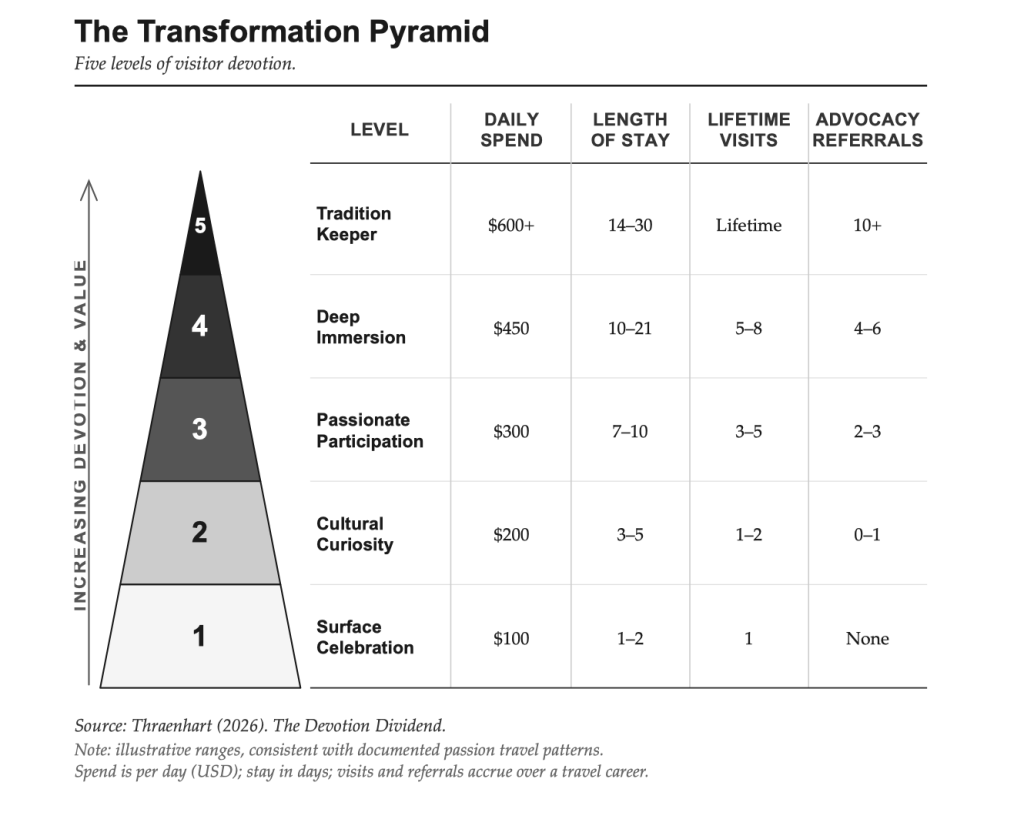
The Transformation Pyramid maps five distinct levels of passionate visitor engagement. Each level has different characteristics, different yield profiles, and different requirements from the destination. Understanding which level your current visitors occupy is the starting point for any serious effort to improve the economics of passion tourism.
Level 1: Surface Celebration
The Level 1 visitor encounters an experience as a spectator or a brief participant. The engagement is primarily visual and sensory. Duration is one to two hours, occasionally a full day. The visitor takes photographs, makes small purchases, and moves on. They may describe the experience positively in a general sense but do not retain specific knowledge or develop a deepened connection to the underlying practice.
The economics at Level 1 reflect the nature of the engagement. Spending is modest. Return rate is low, typically under fifteen percent. Referral behavior is general: “the festival was interesting” is not a recommendation that generates qualified bookings from other passionate community members.
Most destination marketing is built around attracting Level 1 visitors at volume. This is not wrong as a component of a strategy. It becomes a problem when it is the entire strategy, because the economics of Level 1 at scale require enormous throughput to generate meaningful yield, and that throughput typically generates its own costs: infrastructure pressure, quality dilution, and the gradual displacement of the authentic community that made the experience worth visiting in the first place.
Level 2: Cultural Curiosity
The Level 2 visitor wants to understand, not just observe. They seek context. They join guided programs that explain the history, the meaning, the techniques. They extend their stay by a day or two to go deeper than the general visitor. They ask questions. They leave with a framework for understanding what they experienced.
The economics shift at Level 2. Spending is higher, return rates roughly double compared to Level 1, and referral behavior becomes more specific: “if you are interested in this practice, this is worth attending” is a recommendation that reaches the right community members.
The transition from Level 1 to Level 2 is the most important transition in the pyramid. It requires the destination to offer something beyond the spectacle. A guided experience with genuine depth. An explanation that assumes curiosity rather than indifference. This investment is modest and the return is disproportionate.
Level 3: Passionate Participation
At Level 3, the visitor actively participates in the practice rather than observing it. They take a multi-session workshop. They work alongside practitioners. They produce something. They acquire skills, however elementary, that connect them to the community of people who do this thing seriously.
The economic step-change at Level 3 is significant. Duration extends to several days. The specialist program fees are substantially higher than general admission or guided tour costs. Return rates rise sharply because a visitor who has invested time and effort in developing a skill has a reason to return that goes beyond their initial curiosity. They want to see how far they can progress.
More importantly, a Level 3 visitor begins to identify with the passionate community rather than as a tourist observing it. That identity shift is what drives referral behavior within the community: the Level 3 visitor recommends the destination specifically to other members of the practice community, whose qualifications they can assess and who they know will find genuine depth there.
Level 4: Deep Immersion
The Level 4 visitor commits to a multi-day or multi-week intensive engagement. They may live with a practitioner family. They attend ceremonies and contexts that general visitors do not access. They develop a level of knowledge and skill that places them in a genuine relationship with the practice and its community.
Duration at Level 4 is typically one to three weeks. The total economic contribution of a Level 4 visitor is substantially higher than any previous level, reflecting longer accommodation stays, specialist program fees, and significant purchases of materials, equipment, or craft objects connected to the practice.
Return rate at Level 4 approaches certainty for engaged visitors. The relationship built over a deep immersion experience creates a specific reason to return: the practitioner they worked with, the progress they want to continue, the seasonal event they want to attend again. And the referral behavior of a Level 4 visitor within their community is qualitatively different from any previous level. They do not recommend the destination. They recruit for it, sharing specific information about specific access points with specific community members who have specific reasons to go.
Level 5: Tradition Keeper
The Level 5 visitor has crossed from consumer to contributor. They return regularly. They bring others. They may fund programs, support practitioners, or contribute to preservation efforts connected to the practice. Their identity within the passionate community is shaped in part by their relationship with this destination.
The direct transaction value of a Tradition Keeper in any single visit may be lower than a Level 4 visitor, because they often have established relationships that include reduced access costs. Their lifetime value to the destination is not measured in single transactions. One Tradition Keeper who returns annually for a decade, brings a group of fifteen to twenty people on some of those visits, and maintains active community relationships that direct future visitors to the destination generates economic impact that no volume-based calculation can capture.
Why most destinations stay at Level 1
The answer is not lack of ambition. It is measurement.
Destination performance is almost universally measured in arrivals, bed nights, and average spend per visit. These metrics reward Level 1 volume because Level 1 visitors are the most numerous and the easiest to count. They do not capture the repeat visits, the referral yield, the extended program fees, or the community-driven marketing that Level 3, 4, and 5 visitors generate.
A destination that serves five thousand Level 1 visitors in a season will show impressive arrival numbers. A destination that serves five hundred Level 3 visitors will show a fraction of those numbers. The second destination may generate equal or greater total economic yield, much higher retained revenue, a more sustainable relationship with the host community, and far better prospects for the following season. But its performance metrics will look weaker.
This measurement problem drives product decisions across the industry. If what you count determines what you build for, most destinations will continue building for Level 1.
The Transformation Pyramid gives destination managers a parallel measurement framework. What percentage of your visitors reached Level 2 or higher? What was the average per-visit yield at each level? What was the return rate at each level? What percentage of your bookings came through referrals from previous visitors at Level 3 or above? These numbers tell the story that arrival counts conceal.
Designing for advancement
The pyramid is most useful as a design tool when it is applied to the visitor journey as a whole, not just to individual products.
The question is not “how do we design a good Level 3 product?” It is “how do we design the visitor journey so that a Level 1 encounter naturally creates curiosity about Level 2, and Level 2 creates appetite for Level 3?”
A visitor who attends a ninety-minute craft demonstration and leaves without any information about deeper access options stays at Level 1 by default. The same visitor, given a clear explanation of what a week-long practitioner workshop involves, introduced briefly to someone who has done it, and handed a specific booking pathway for the next program, has a real chance of returning at Level 2 or 3.
The transition infrastructure between levels is where most destinations under-invest. The product exists. The visitor’s curiosity exists. The pathway between them is missing.
The arithmetic
The case for investing in higher pyramid levels is ultimately mathematical. It requires fewer total visitors to generate the same yield when a larger proportion of those visitors are at Level 3 and above. It generates higher retained local revenue because specialist program fees flow to practitioners and knowledge holders rather than to general accommodation and transport. And it builds a community of advocates whose referral behavior reduces acquisition costs over time.
A destination that attracts one thousand Level 1 visitors and five Tradition Keepers has a very different economic profile than a destination that attracts two hundred Level 3 visitors and twenty Tradition Keepers. Both may report similar arrival numbers in aggregate. Only one is building toward a sustainable position.
The Transformation Pyramid does not suggest that Level 1 visitors are unwelcome. It suggests that they should be seen as a starting point rather than an endpoint. The visitor who spends ninety minutes at the festival today and goes home is not lost. They are at Level 1. The question is whether the destination has given them a reason and a pathway to return at Level 2 or 3.
Most have not. That is the gap.
Dr. Jens Thraenhart is the founder of Destinspire and CEO of Chameleon Strategies. The Transformation Pyramid is introduced in Chapter 5 of his forthcoming book The Devotion Dividend, Book 1 of The Passion-Tourism Economy series, publishing in late 2026. The framework is included in the Passion Tourism Strategy Workbook, available at Destinspire.com alongside destination case studies, passion community profiles, and implementation tools.
 BALANCED TOURISM
Leave a comment