
How Geopolitics Is Redrawing Travel, and Why It Points Back to Balance
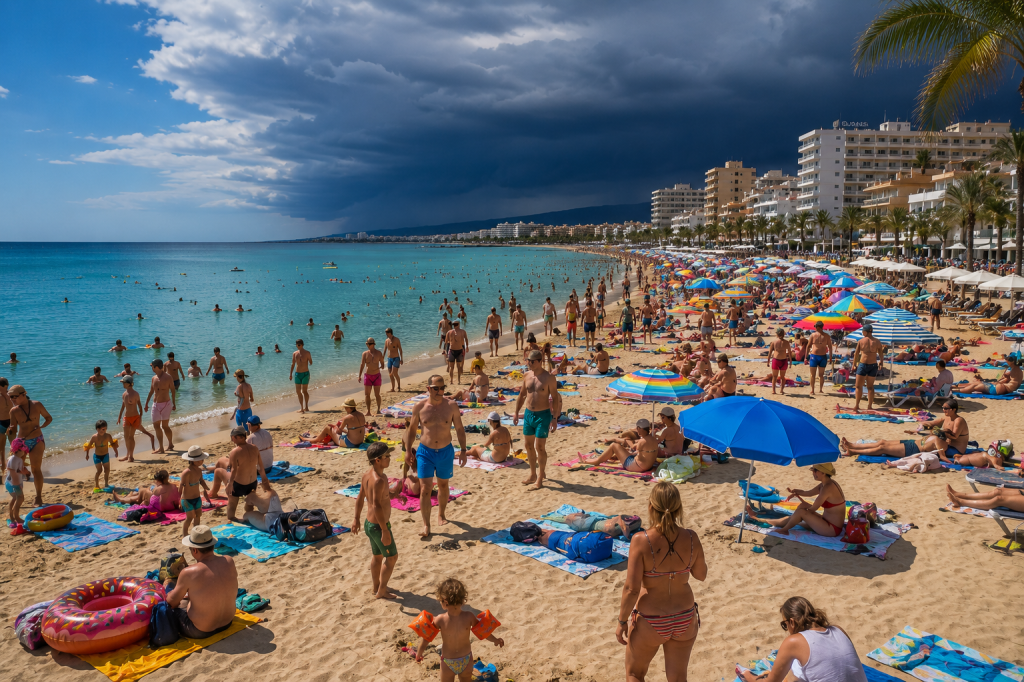
Tourism has rarely looked stronger, and the ground beneath it has rarely felt less settled. International arrivals reached an estimated 1.52 billion in 2025 according to UN Tourism, growth broadly in line with the sector’s pre-pandemic path, and the World Travel and Tourism Council now puts travel and tourism close to a tenth of global output. In the same season, the World Economic Forum’s 2026 risk assessment ranked geoeconomic confrontation as the most likely trigger of a global crisis, with armed conflict close behind. Both things are true at once, and the space between them is where this piece lives.

I have started to call that space the Next Tourism Order. It is a framework I have been developing to describe how a more fragmented, more contested world is quietly rebuilding the system that carries travellers, and what that change asks of the people who run destinations and travel businesses. This is its first edition. I intend to revisit it each year, and sooner whenever a geopolitical or structural shift moves the order enough to matter.
The trap of reading the headline
The easy move is to read the arrivals figure, note the record, and relax. The problem is that aggregate demand is the most lagging indicator we have. It tells us what travellers already did, not what the system underneath them can absorb. A destination can post its best year on paper while the corridors, costs and politics that made that year possible are being rewritten in the background.
That is the pattern I kept seeing across Asia, the Gulf and beyond while researching my forthcoming book on the passion-tourism economy. The growth was real. So was the fragility sitting just below it. Reading one without the other is how good operators get surprised.

Five forces redrawing the order
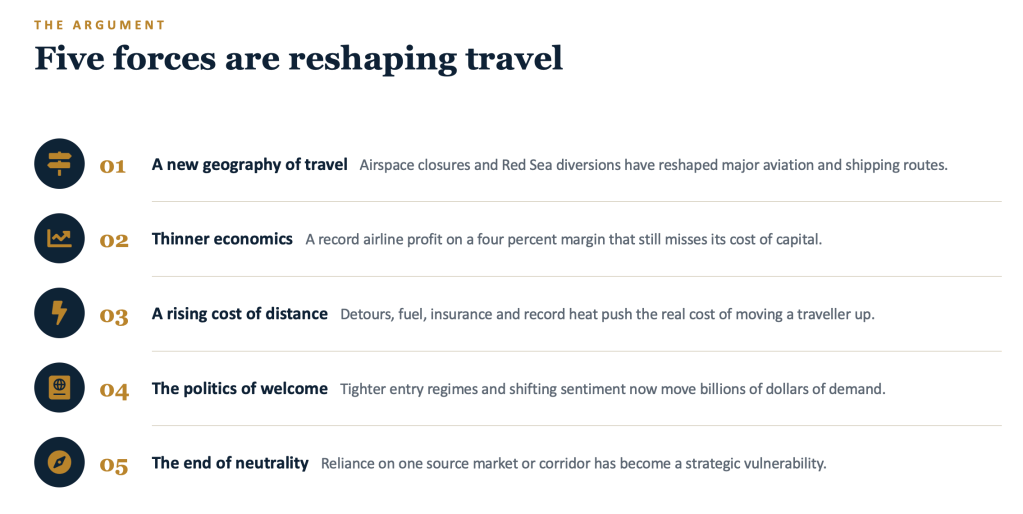
The changes kept resolving into five forces that work together rather than alone.
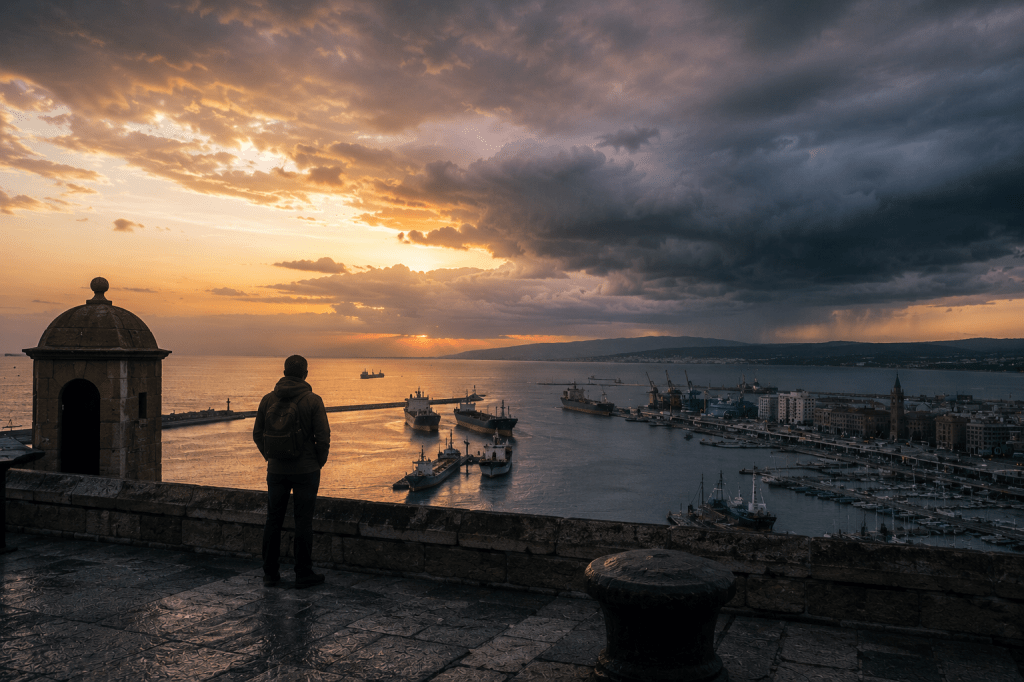
The first is a new geography of travel. Closed airspace and shipping diversions have rerouted aviation and maritime traffic at the same time, turning hub, route and itinerary choices into something closer to geopolitical bets.
The second is thinner economics. An industry can look profitable in aggregate and still be financially brittle, earning record headline numbers on margins too slim to rebuild a reserve before the next shock arrives.
The third is a rising cost of distance. Longer routes, fuel, insurance and record heat are all pushing up the real cost of moving a single traveller, and that cost is becoming more volatile, not less.
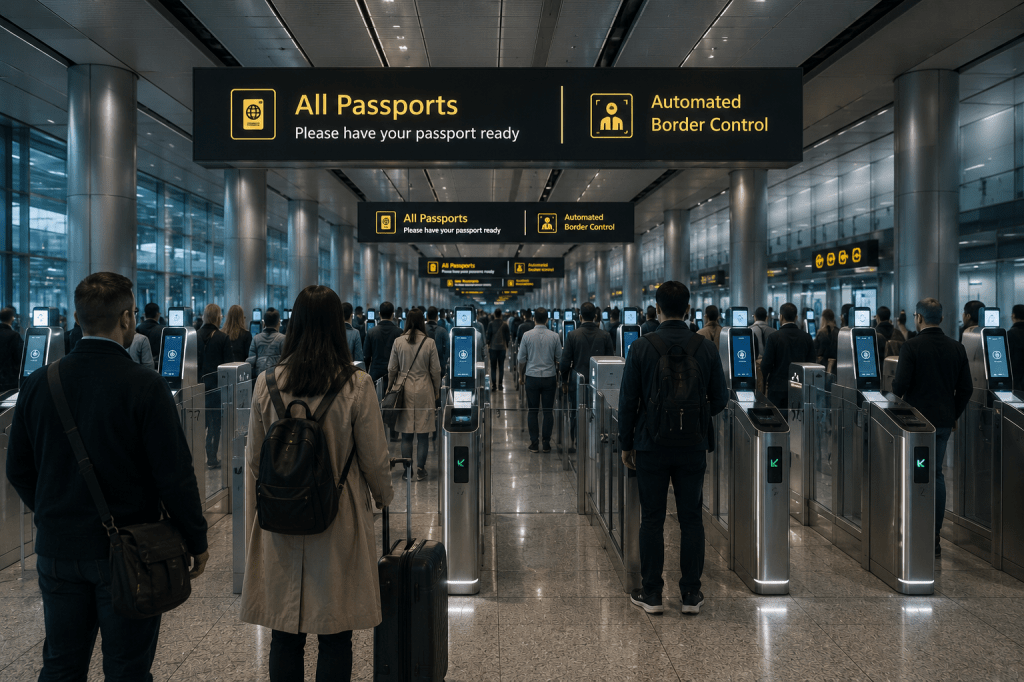
The fourth is the politics of welcome. Entry regimes are tightening, biometric controls are spreading, and public sentiment toward visitors now moves real money in both directions. Welcome has become conditional and, in places, contested.
The fifth is the end of the neutral destination. Leaning on one source market, one corridor or one season is no longer a quiet default. It is exposure. The places that thrive in this order are choosing their position on purpose and investing through the cycle rather than waiting for calm to return.

Where the Next Tourism Order meets Balanced Tourism
This is the part that matters most on this blog. Balanced Tourism has always argued for equilibrium between the economic, social and environmental sides of travel, for keeping more value inside the destination by reducing leakage, and for growth that does not erode the very place it depends on. For years that case rested mainly on sustainability and community grounds. It was the right thing to do.
The Next Tourism Order adds a harder, more commercial reason to arrive at the same conclusion. In a fragmenting world, balance is also how you stay standing.
Diversifying source markets, segments and seasons is the central argument of Balanced Tourism, and it is now also basic risk management, the difference between a manageable year and a lost one when a single dependency turns. Protecting resident consent and social licence has long been a matter of fairness, and it is now also an operating requirement, since a destination that loses its community cannot quietly assume it will keep its access. The case for high-yield over high-volume travel reads differently when the cost of moving each traveller is rising and volatile. Spreading flows across the calendar and the map, long a tool for easing pressure on crowded places, is now also how a destination hedges against heat, shocks and seasonal concentration.
In other words, the strategy that keeps a place liveable and the strategy that keeps it resilient have converged. What looked like an ethical preference is becoming a structural one. That convergence is the throughline I have been tracing on this blog for some time, most recently in Three Crises, One Industry, and it is what the Next Tourism Order tries to name in full.

From reading headlines to building reserves
If the order is changing, the response is not a crisis manual left in a drawer. It is a set of reserves built in the good years and drawn down in the hard ones.
Demand diversity asks whether you could still fill capacity if your largest source market halved. Capital asks whether you could absorb two weak quarters without distress. Operational optionality asks how fast you could reroute if a corridor or a key supplier closed tomorrow. Stakeholder trust asks whether host communities, staff and travellers still want you operating at all. A fifth discipline governs the other four: foresight, the habit of watching freight rates, war-risk premiums, advisories, currencies and sentiment, with the response agreed before the shock rather than improvised after it.
These are the same instincts that sit at the heart of strength-based destination strategy. The Next Tourism Order simply raises the stakes for getting them right.
A living framework
I am publishing this as a first edition on purpose. The order it describes is not fixed, and a framework that pretends otherwise would age badly. I will update it once a year as a matter of routine, and ahead of schedule whenever a geopolitical or structural event shifts the picture enough to change the advice. A closed corridor that reopens, a major market that turns, a new entry regime that reshapes flows: each of those would be a reason to revisit the order rather than wait for the calendar.
The fuller argument, with the evidence base and the four scenarios I would plan against rather than try to predict, is set out in a short eBook of the same title. There is also a free executive briefing for readers who want the summary first. Both are linked below.
Tourism remains one of the few forces that still moves people across the lines now hardening, which gives the sector an unusual exposure to instability and an unusual stake in keeping openness alive. Reading the structure beneath the demand curve, rather than being reassured by the curve itself, is the discipline this decade rewards. Clarity, not fear, is the advantage.
Read the full The Next Tourism Order eBook (USD 4.50): https://thraenhart.gumroad.com/l/NextTourismOrder
Feel free to read the The Next Tourism Order – Free Executive Briefing below.
The Next Tourism Order is a framework developed by Dr. Jens Thraenhart, founder and CEO of Chameleon Strategies and a UN Tourism Affiliate Member. This is the first edition, updated annually or when events significantly change the tourism order.


Leave a Reply