

One index turned into five. Here’s why, and what happens when you combine them wrong.

The first version of this had one number.
It measured whether a passion was genuinely alive in a destination or being performed for visitors, and it worked for the cases it was built to catch. Then I ran it against stargazing in the Gobi Desert, and it broke.
The Gobi Desert scored near the top of the authenticity scale. Correctly. Nothing there has been staged for anyone. It also turned out to be a destination almost no one could actually visit well. No accommodation built for a night under that sky. No trained guides. No route in without days of overland travel. A high authenticity score told half the truth and let the other half go unsaid.
So I added a second index, measuring whether a destination had actually built the means to receive a devoted visitor. That fixed the Gobi Desert problem and created a new one immediately. A destination could now score high on infrastructure while the authenticity underneath it had been hollowed out by the exact commercial pressure that infrastructure investment tends to bring. Sedona’s dark sky tourism is a real example of this: good roads, real lodging capacity, and a wellness marketing narrative that now shapes the visitor experience as much as the astronomy does.
Every addition since followed the same pattern. A devoted traveler cares whether a specific destination delivers what their specific passion needs, which is a different question from whether the passion is alive and the infrastructure exists in the abstract. That became a third index. A community can host an authentic, well-built passion tourism product and capture almost none of the resulting revenue, which is a different question again. A fourth index. And a passion can do all of the above while depending entirely on eight weeks of peak season and two source markets, a durability question none of the first three ever asked. A fifth.
Five indices in, a new problem showed up, and it wasn’t conceptual this time. It was arithmetic.

The Blending Problem
Combine five scores into one the obvious way, a weighted average, and you recreate the exact failure the second index was built to prevent. A weighted average lets strength in four dimensions quietly cover for catastrophic failure in a fifth.
Take a destination that scores 30 on authenticity and 90 or better on everything else. A weighted average puts that around 68. That reads as solidly good. It is not solidly good. A 30 on authenticity means the passion is barely alive, close to fully staged. No amount of excellent infrastructure changes that fact, and a composite that lets infrastructure paper over it is actively misleading whoever reads the number.
The fix is what I’m calling an Integrity Multiplier: the weighted average of all five indices, multiplied by the square root of whichever single index scored lowest, expressed as a fraction of 100.

A square root, specifically, because of how it behaves at the extremes. It punishes a genuinely low score hard. It doesn’t needlessly crush a destination whose weakest dimension is merely moderate. A destination whose weakest index is 90 loses almost nothing to the multiplier. A destination whose weakest index is 20 loses more than half its score.
One more thing the formula does that surprised me when I first ran it: a destination that’s a flat, unremarkable 70 across all five indices doesn’t score 70. It scores about 59. Moderate everywhere is a genuinely worse outcome than excellent in most dimensions and weak in one, not an equivalent one, and the Purpose Score treats it that way.
The Five Questions
Passion Pulse Index (PPI) asks whether the passion is genuinely alive, or performed for visitors. Six dimensions: the depth of the local practitioner community, how independent the passion is from tourism, who controls the experience, whether a devoted visitor can find it unscripted, whether commercial pressure has diluted it, and the warmth of the welcome itself, a dimension I call Host Spirit, after hospitality traditions like Saudi Hafawa and Japanese Omotenashi, where hosting well is personal pride rather than a service script.
Passion Access Index (PAI) asks whether the destination has built the means to experience it well. Six dimensions covering accommodation, guiding depth, logistics, capacity management, interpretive materials, and the specific physical infrastructure a passion actually requires, a bird hide, a viewing platform, a beehouse, distinct from lodging or signage.
Passion Fit Index (PFI) asks whether this specific place delivers what someone serious about this specific passion is looking for. Four dimensions, and they change depending on the passion: sky quality and accessibility for stargazing, flavor diversity and street food depth for gastronomy. Forcing every passion into the same four boxes would flatten the thing this index exists to capture.
Passion Impact Score (PIS) asks whether the resulting revenue actually stays in, and benefits, the community. Six dimensions: revenue retention, local ownership, employment quality, community decision-making, reinvestment in the asset, and whether benefit is broadly distributed or concentrated in a few large operators. This is the most direct measure of Purpose in the sequence this book series argues for, Purpose before Passion before Profit. A destination can score well on the first three indices and fail this one badly, and when that happens, it’s not a rounding error.
Passion Diversification Index (PDI) asks whether the passion spreads benefit across geography, season, and source market, or concentrates the exact pressure a destination already carries. Three dimensions, kept to three deliberately, since geographic, seasonal, and market concentration are three distinct risks, not six. A destination can be authentic, well-built, well-fitting, and fairly distributed, and still be one bad season and one market’s travel pattern away from real exposure.
Two Destinations, Same Infrastructure, Opposite Outcomes
Rwanda’s mountain gorilla trekking and Shaolin Temple’s martial arts tourism both score in a broadly similar range on Access and Fit, both around 60 to 90. Their Purpose Scores land nowhere near each other.
Rwanda: Purpose Score 65
The permits are not the obstacle. They are the reason this still exists to visit.

Pulse 78, Access 91, Fit 88, Impact 80, Diversification 67. Trackers, several of them former poachers who now build careers around the animals they once hunted, deliver genuinely expert guiding. Permits cap daily visits at ninety-six, fund conservation in the hundreds of millions since the mid-2000s, and direct meaningful revenue-share back to communities near the park. The single weak point, Diversification, isn’t a failure so much as an honest fact: Volcanoes National Park doesn’t relieve tourism pressure elsewhere in Rwanda, because it is Rwanda tourism’s main event, not a secondary attraction. That’s a real, actionable finding, and the index surfaces it precisely because it doesn’t get to hide behind four other strong numbers.
Shaolin Temple: Purpose Score 24
The training halls are real. What happens inside them, less so.

The infrastructure is genuinely there: training academies, strong transport links, a well-developed visitor experience. What isn’t there anymore is the thing the infrastructure was supposed to protect. Decades of commercialization have replaced authentic transmitted martial arts practice with theatrical performance for tourists, documented across this book series’ case study library as close to the most complete authenticity failure on record. Good roads and a functioning visitor center do not rescue the score, because the Integrity Multiplier will not let them. A single catastrophic Pulse score of 24 caps the entire composite regardless of what the other four indices say.
That’s the whole argument, in two numbers that happen to sit right next to each other on paper and land nowhere near each other in reality.
The Rest of the Set
Five more destinations, summarized rather than fully unpacked, each one a different reason the Purpose Score landed where it did.
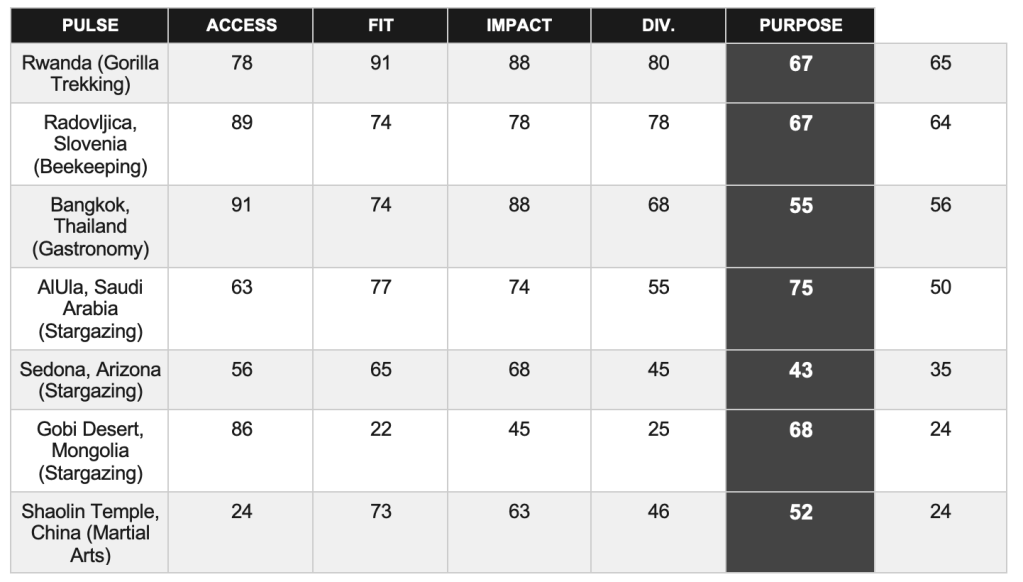
Gobi Desert, Mongolia: 24
No lodge is built for this sky. That is what makes it real, and what makes it hard to reach.

The mirror image of Shaolin, for a completely different reason. Pulse reaches 86, genuinely unstaged, nomadic astronomical knowledge that predates tourism by generations. Access is 22. No accommodation built for a night under that sky, no trained interpretation, days of overland travel with no established support. Impact sits at 25, because there’s barely a formal tourism economy yet to capture visitor spending at all. Two completely different failure modes, Shaolin and the Gobi Desert, land within a point of each other on the composite. That’s not a coincidence. That’s the Integrity Multiplier doing exactly what it’s built to do.
AlUla, Saudi Arabia: 50

A newer, government-led astro-tourism programme, Pulse 63, held up specifically by Host Spirit, since Saudi Hafawa is a hosting tradition that predates this specific programme by generations. The weakest link here is Impact at 55, a young programme that hasn’t yet built deep community revenue-sharing.
Sedona, Arizona: 35
Real infrastructure, Access 65, layered with a spiritual and wellness marketing narrative that has come to define the experience as much as the astronomy does, Pulse 56. Diversification is the weakest link at 43: Sedona is already a saturated US tourism draw, not relieving pressure anywhere, and doesn’t meaningfully reach new source markets.
Bangkok, Thailand: 56
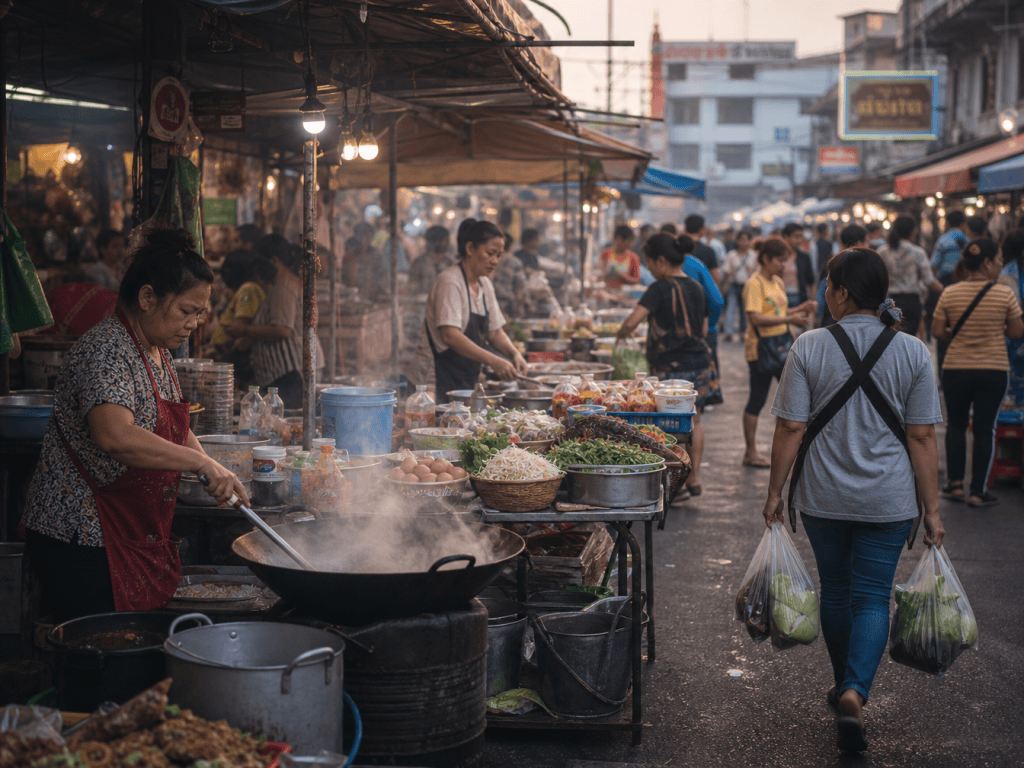
The highest Pulse in this set, 91, food that was never built for visitors and never will be. What pulls the composite down is Diversification at 55: Bangkok is already Thailand’s central tourism hub, and gastronomy tourism there doesn’t spread benefit to under-visited regions or open genuinely new source markets. Even an excellent passion, delivered excellently, can’t escape a structural concentration problem.
Radovljica, Slovenia: 64

The most balanced set of scores in this pilot: Pulse 89, Impact 78, a national beekeeping tradition with formal certification and legal protection for native bee genetics. Its own weak point is Diversification at 67, similar to Rwanda’s story, a genuinely strong destination whose next challenge is spreading what it has built rather than fixing what’s broken.
What This Means in Practice
The Purpose Score’s real value isn’t as a leaderboard. It’s as a diagnosis. A low Pulse score inside strong everything else means stop building and start protecting, marketing and more infrastructure will make it worse, not better. A strong Pulse with weak Access or Fit means invest, carefully, sequenced through SOAR so the investment doesn’t become the next authenticity failure. A weak Impact score, regardless of what else looks good, means the revenue model needs to be redesigned, not the marketing. A weak Diversification score, often sitting underneath an otherwise excellent destination, is a dependency to manage rather than a failure to fix.
Five different numbers point toward five genuinely different responses. That’s the entire reason this couldn’t stay one number.
The full framework, complete scoring rubrics for all five indices, and the self-assessment and comparison tool are at Destinspire.com/purpose.
Dr. Jens Thraenhart is the founder of Destinspire and CEO of Chameleon Strategies, based in Bangkok. He is the author of The Passion-Tourism Economy series and served as CEO of Barbados Tourism Marketing Inc. (2021-2023), Executive Director of the Mekong Tourism Coordinating Office (2014-2021), and Advisor to the Saudi Tourism Authority (2024-2026).
Full assessment tool and methodology: Destinspire.com/purpose
The Devotion Dividend: PassionTourismEconomy.com
Download the Passion Purpose Index White Paper at https://www.destinspire.com/purpose/white-paper and view the eBook below:
References
Al-Rasheed, M. (2010). A history of Saudi Arabia. Cambridge University Press.
Hardin, G. (1968). The tragedy of the commons. Science, 162(3859), 1243-1248.
MacCannell, D. (1973). Staged authenticity: Arrangements of social space in tourist settings. American Journal of Sociology, 79(3), 589-603.
Stavros, J. M., & Hinrichs, G. (2009). The thin book of SOAR: Building strengths-based strategy. Thin Book Publishing Company.
Takahashi, E. (2026, August 5). Omotenashi meaning: The Japanese art of hospitality. Japanese Rituals. https://japaneserituals.com/omotenashi/
Thraenhart, J. (2025, October). Introducing the strength-based strategy framework to drive high-yield tourism. BalancedTourism.com. https://balancedtourism.com/2025/10/10/introducing-the-soar-strength-based-strategy-framework-to-drive-high-yield-tourism/
Thraenhart, J. (2026, January 15). Tourism’s authenticity revolution: How the 3S Framework created the blueprint for cultural soft power for Saudi Arabia. BalancedTourism.com. https://balancedtourism.com/2026/01/15/tourisms-authenticity-revolution-how-the-3s-framework-created-the-blueprint-for-cultural-soft-power-for-saudi-arabia/
Thraenhart, J. (2026). The Devotion Dividend. Chameleon Strategy Press.
Visit Saudi. (2024). Hafawa: The heart of Saudi hospitality. https://www.visitsaudi.com/en/stories/hafawa
Wang, N. (1999). Rethinking authenticity in tourism experience. Annals of Tourism Research, 26(2), 349-370.
About the Author
Dr. Jens Thraenhart founded Chameleon Strategies in 1999, building the firm into a respected consultancy and venture incubator across the travel, tourism, hospitality, and leisure lifestyle industries.
Over more than two decades, Jens has worked at the intersection of tourism strategy, destination marketing, and digital transformation. He has led organizations at the highest levels, serving as CEO of Barbados Tourism Marketing Inc. and as Executive Director of the Mekong Tourism Coordinating Office for four consecutive terms, and most recently as Advisor to the Saudi Tourism Authority.
He founded or co-founded various successful ventures, including Dragon Trail, Digital Innovation Asia, Blogger Matchup, Destination Film Forum, Destination Mekong, Enwoke, High-Yield Tourism, Saudi Outbound, Filara Fine Textiles, Zero Proof Vino, Passion Explorer, and Destinspire.
Jens is currently on the UN Tourism Affiliate Members Board, served as its 2nd Vice Chair for two consecutive terms, and was a board member of the Pacific Asia Travel Association (PATA). He is deeply engaged in shaping global tourism policy and practice, with particular focus on sustainable development, digital innovation, and the Passion-Tourism Economy.
His academic credentials include a Doctorate in Hotel and Tourism Management from The Hong Kong Polytechnic University and an MBA-accredited Master of Management in Hospitality from Cornell University. He also holds a Bachelor of Science from the University of Massachusetts Amherst and the Cesar Ritz Colleges in Switzerland.
Besides contributing to various books and publications, he is the author of the Saudi Outbound Tourism book, and the Passion Tourism Economy book series. He publishes the Balanced Tourism and Tourism Campaigns websites, and was publisher/editor of the Mekong Stories book, and the China Travel Trends book.


Leave a Reply